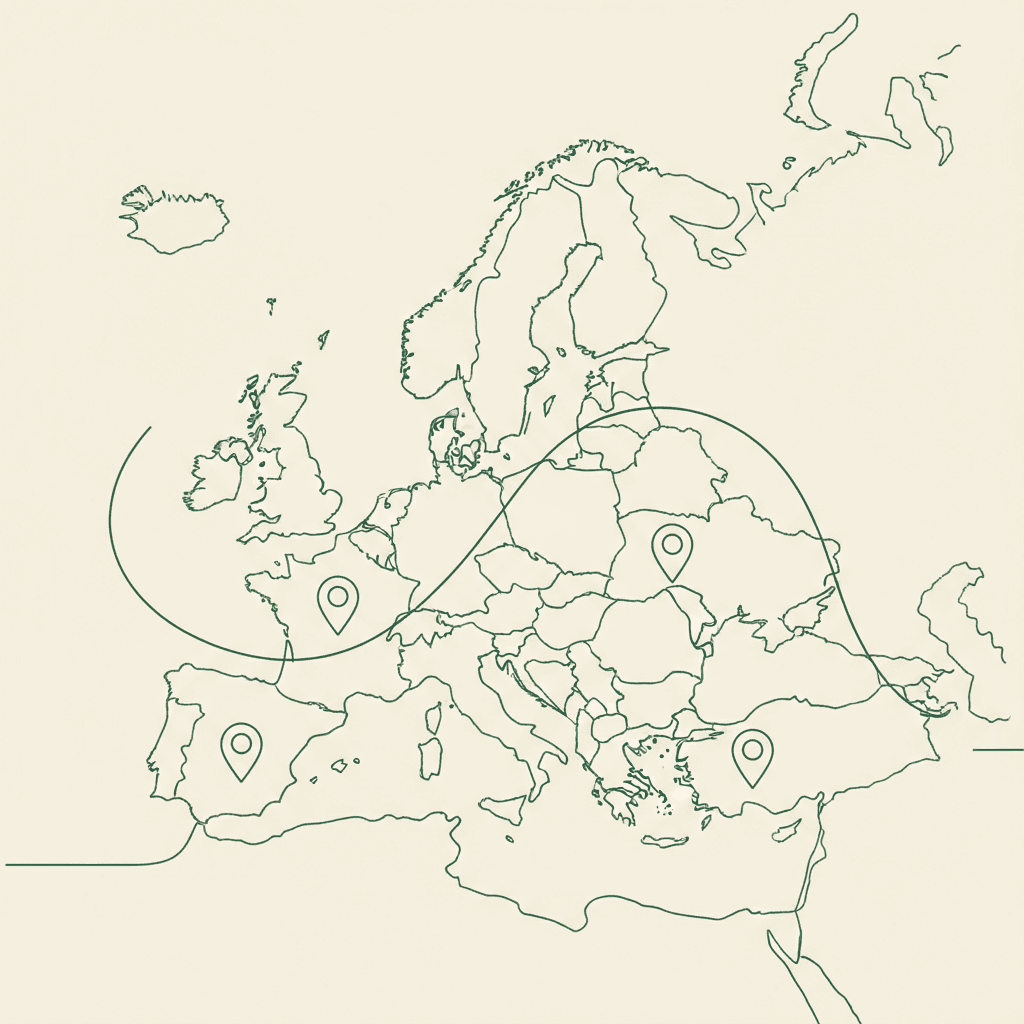
Distributor territory management is the practical discipline of deciding who may sell what, to whom, and where in a wholesale network. For a Nordic or EU brand, it prevents two distributors approaching the same retailer, clarifies responsibility for market development, and gives finance and operations a clearer route from order to invoice.
The framework is straightforward: map the market, define territory rules, assign accounts, document exclusivity, create an overlap process, and review performance. The difficult part is applying those steps consistently when orders, retailer details and distributor conversations live across email, spreadsheets and disconnected systems.
What is distributor territory management?
Distributor territory management is the process of defining market areas, assigning retailer accounts and managing distributor responsibilities. It turns a broad distributor relationship into an operating model that sales, finance, operations and partners can follow.
A brand owns or represents the products being sold. A distributor buys, promotes or resells those products within an agreed scope. A retailer sells products to the end customer, while a wholesale account is the business record used to manage that retailer or other approved business buyer.
A sales territory is not always a country on a map. It can combine several dimensions:
| Territory type | What it defines | Example |
|---|---|---|
| Geographic territory | A physical market area | Sweden, the Benelux region, or selected German states |
| Customer-segment territory | A type of buyer | Independent design stores, pharmacy chains, or hospitality buyers |
| Channel territory | A route to market | Physical retail, online retail, travel retail, or contract sales |
| Product territory | A product range | One distributor handles core products while another covers professional-only lines |
The objective is not to make the structure complicated. It is to make ownership clear enough that a retailer receives consistent service and distributors know where to focus.
 A simplified map with distinct coloured trading areas connected by clean routes
How should a wholesale brand define distributor territories?
Start with the route to market rather than the first available distributor. Territory planning for wholesale should reflect how customers buy, who can serve them well, and where the brand needs deliberate coverage.
A useful market map records:
- priority countries, regions and cities;
- retailer types and buying groups;
- relevant sales channels;
- language, service and delivery requirements;
- existing retailer relationships and inbound leads;
- product lines that need specialist knowledge; and
- the distributor capacity required to open and support accounts.
For example, a home and design brand may appoint one partner for independent retailers in Sweden and Finland, while retaining national chains as house accounts. A health and beauty brand may separate pharmacy, salon and general retail channels because each needs different relationships and product knowledge.
Before appointing a distributor, decide whether the brand will sell directly in any market. The answer affects pricing, account ownership and service obligations. This guide to wholesale distribution models can help establish where direct sales, distributors or a mixed approach make sense.
Use a territory brief, not just a territory name
A country name alone leaves too much open to interpretation. Give each territory a short written brief that states:
- the geographic boundary;
- permitted channels and customer segments;
- included and excluded product lines;
- named accounts already owned by the brand or another partner;
- the distributor's responsibilities for prospecting, ordering and support; and
- the date and conditions for review.
This document becomes the reference point when a new retailer arrives through a trade fair, referral or website enquiry.
Should distributor territories be based on countries, regions or customer types?
Country-based territories are easy to explain, but they are not always the most practical model. They work best when a distributor has strong national coverage, local-language service and responsibility for a clear local retailer base.
Regional territories can suit markets with shared logistics, similar buyer profiles or one distributor that already serves neighbouring countries. Customer-type territories work when a buyer group crosses borders, such as a retail chain, a hotel group or a specialist online retailer.
A hybrid model is often more workable for EU distributor management. For instance, a distributor might own independent retailers in a named country while the brand retains strategic chains, marketplaces or key online accounts. The key is to define the exception, not merely mention it verbally.
Avoid creating a structure that changes for every opportunity. If exceptions become common, the territory design probably needs revisiting.
How do you assign retailer accounts to distributors?
Distributor account allocation should follow an agreed decision sequence, not who happened to contact the retailer first. A consistent process protects partner trust and makes retailer account management easier as the network grows.
Assess a prospective account using these questions:
- Location: Where is the retailer's buying office, delivery destination and main trading activity?
- Channel fit: Does the account sit within the distributor's permitted route to market?
- Existing relationship: Has the brand, distributor or another partner already developed the opportunity?
- Capability: Can the distributor provide appropriate sales support, local service and replenishment?
- Product fit: Does the distributor have rights to the relevant range?
- Conflict risk: Would the assignment overlap with a house account, another territory or a named exception?
A house account is an account retained and managed directly by the brand rather than assigned to a distributor. House accounts commonly include strategic chains, long-standing direct customers, or accounts that require central commercial management. List them explicitly. An unwritten “we will handle the big accounts” rule is a reliable source of dispute.
Lead ownership is the agreed right to progress a specific sales opportunity. It should be recorded separately from general territory ownership, particularly for cross-border buyers. A retailer based in one country may have a purchasing team elsewhere, operate stores in several markets, or request delivery through a central warehouse.
For the wider process of keeping account records current after allocation, see this guide to practical wholesale account management.
 Two sales paths meeting at one retailer storefront while a clear routing line selects one owner
What should a distributor exclusivity agreement include?
Exclusive distribution gives one distributor sole or primary rights within a defined scope. Non-exclusive distribution allows the brand to appoint more than one partner or sell directly within that scope. Neither model is automatically better; the appropriate choice depends on the market plan, partner capability and level of control the brand needs.
Commercial agreements should be drafted and reviewed by appropriate legal advisers, especially where they cover cross-border trade or competition-related restrictions. Software can record and support an agreed process, but it cannot replace the agreement or legal review.
At a practical level, the agreement and its supporting schedule should cover:
- territory boundaries and defined channels;
- approved accounts and house-account exclusions;
- product scope, including new launches and discontinued lines;
- whether rights are exclusive, non-exclusive or conditional;
- expectations for sales activity, account development and reporting;
- stock, forecasting, payment and service responsibilities;
- rules for leads, trade fairs, online enquiries and cross-border orders;
- review dates, remedies for underperformance and change procedures; and
- exit terms, including treatment of open orders, stock and retailer relationships.
Write exceptions in the same level of detail as the main territory. For example, if a distributor may sell to independent retailers but not national chains, identify how a chain is defined and who approves borderline cases. A wholesale terms and conditions checklist is a useful companion for documenting the wider trading relationship.
How can brands prevent distributor territory overlap and channel conflict?
Channel conflict management is the process of identifying and resolving clashes between sales routes, partners or account owners. It is easier when the brand has a documented workflow before conflict occurs.
Use an account registration process for new prospects. Account registration records the distributor, retailer, date, channel, territory, product interest and current status. It does not need to be bureaucratic, but it should answer a simple question: who has approval to develop this opportunity?
A workable overlap process looks like this:
- The distributor registers the prospective account before meaningful commercial work begins.
- The brand checks for an existing account, house-account status, another active lead or a channel exception.
- The brand approves, declines or conditionally assigns the lead in writing.
- The decision is visible to the relevant internal owner and distributor.
- Disputed cases go to a named commercial decision-maker within a defined internal process.
- The outcome is recorded, including any change to future territory rules.
Treat cross-border orders as a specific scenario, not an afterthought. Decide which factors control ownership: the buying entity, retailer headquarters, delivery location, selling channel or registered lead. Then apply the same rule consistently.
Operational visibility helps here. Brandgate can give approved partners a branded place to order, while retailer onboarding can capture ownership details alongside account approval. Multi-currency catalogues, VAT-aware invoicing and Fortnox sync can reduce manual administration after territory decisions have been made. They support the operating model; they do not decide commercial rights.
Which distributor performance metrics should brands review?
Distributor performance metrics should show both market development and day-to-day execution. Looking only at order value can hide weak retailer coverage, poor reordering or operational problems that eventually affect the relationship.
Review a balanced set of measures:
- Sell-in: Orders placed by the distributor into its retailer network.
- Sell-through: Sales from retailers to end customers, where the distributor or retailer can share reliable information.
- Reorder rate: Whether accounts come back for replenishment after initial orders.
- Active accounts: Retailers that are currently ordering or being meaningfully developed.
- Account coverage: Whether the distributor is reaching the agreed customer types and locations.
- Forecast accuracy: How closely expected demand aligns with actual ordering needs.
- Payment performance: Whether invoices and credit arrangements are managed reliably.
- Service levels: The quality of communication, order handling, availability updates and issue resolution.
The right interpretation matters more than a long dashboard. Low sell-in may reflect weak prospecting, but it may also indicate an unsuitable assortment, late stock, a pricing issue or unclear territory rights. Combine performance reviews with account-level discussion and, where possible, tracking wholesale sell-through.
 A calm dashboard-like arrangement of parcels, product shelves and a compass with no written markings
How often should distributor territories be reviewed?
Review distributor territories on a regular business cadence and whenever a material change occurs. A scheduled review keeps assumptions from becoming permanent simply because nobody revisited them.
A territory review should examine account lists, sales activity, retailer coverage, product fit, operational issues and open conflicts. Confirm whether the distributor still has the capacity and incentives to serve the scope it was given.
Also trigger a review when there are missed commitments, repeated account disputes, a new channel launch, supply constraints, a major retailer opportunity, a distributor ownership change or a meaningful shift in the market. Do not wait for a contract renewal if the territory design is already causing friction.
Turn the framework into a repeatable operating routine
Keep one current territory register with the territory brief, distributor, approved account list, house-account list, lead registrations, exceptions and next review date. Make one internal person accountable for maintaining it, even if several teams contribute.
When the register, ordering process and finance workflow reflect the same ownership rules, the brand can grow without rebuilding its operating model for every market. For pricing decisions that accompany cross-border territories, read the guide to B2B multi-currency pricing.
If you are evaluating a more connected way to manage distributor ordering and wholesale operations, Book a demo with Brandgate. You can also see pricing.