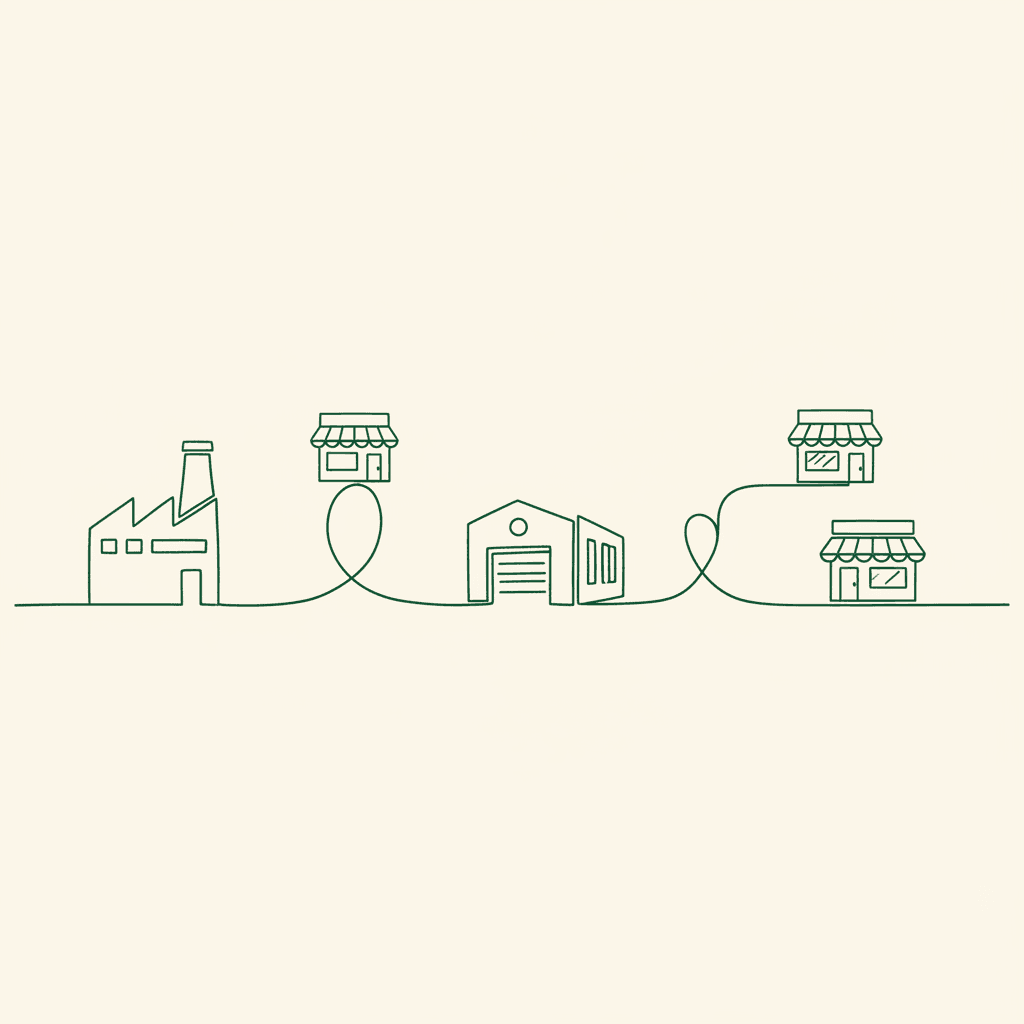
A wholesale distribution model is the structure a manufacturer or wholesale brand uses to sell products into its B2B wholesale channel. The core choice is whether to sell directly to retailers, sell through distributors, or combine both routes.
There is no universally best wholesale distribution strategy. The right option depends on the markets you serve, the relationships you need to own, the support your buyers expect, and the operating capacity behind your sales plan.
What is a wholesale distribution model?
A wholesale distribution model sets the route from brand or manufacturer to the buyer that will resell the product. It also determines who owns key commercial and operational work: customer acquisition, pricing, retailer support, inventory allocation, delivery coordination, invoicing and collections.
The terms are related but not interchangeable:
- A manufacturer makes the product, whether in-house or through a production partner.
- A wholesale brand sells goods in volume to business buyers rather than primarily to end consumers.
- A retailer sells products to the end customer.
- A distributor buys from, represents or resells for a brand within an agreed market, channel or territory. It often brings local sales relationships and market knowledge.
- A wholesaler is a business that buys goods in bulk and resells them to business buyers. A wholesaler may distribute many brands without acting as a dedicated market-development partner for each one.
Your model should be documented in commercial terms, not left to informal assumptions. This includes account ownership, price lists, payment terms, delivery responsibilities, returns handling, territory and channel exclusivity, and the information each party must share.
 A product moving from a workshop through two branching paths to independent shops
How does selling directly to retailers work?
Direct-to-retailer sales mean the brand sells to and supports the retailer itself. The brand’s sales team, founder or account manager wins the account, agrees terms, accepts orders, fulfills them and manages the ongoing relationship.
This route gives the brand a direct view of each retailer’s assortment, ordering pattern, feedback and support needs. It can also make it easier to introduce a new collection, adjust account plans, and decide which retailers fit the brand’s positioning.
Direct selling asks more of the brand, however. It must build the prospect list, qualify buyers, manage many individual accounts and answer order questions. As the retailer network grows, manual email orders, spreadsheet price lists and disconnected invoicing become harder to control.
Direct-to-retailer wholesale is often a good fit when:
- The brand wants close control over retailer selection and presentation.
- Buyers need product knowledge, merchandising guidance or frequent contact.
- The market is familiar enough for the brand to sell and support accounts effectively.
- The brand has the capacity to handle acquisition, account management and fulfilment.
A direct model does not mean every account receives the same treatment. Set clear retailer tiers, order rules and service expectations. A minimum order quantity (MOQ) is the smallest order a buyer can place under agreed terms. It can help make smaller wholesale accounts practical to serve, but it should match the product, fulfilment process and commercial relationship.
For the commercial side, it helps to separate acquisition from long-term ownership. A repeatable practical wholesale account management approach makes it clearer who follows up, who handles issues and what a healthy retailer relationship looks like after the first order.
What are the advantages and disadvantages of selling through distributors?
Distributor-led sales mean a distributor takes the lead in selling a brand into a defined market, territory, retailer group or channel. Depending on the agreement, the distributor may buy and hold stock, place orders against demand, arrange local delivery, invoice retailers, or perform a more limited sales role.
The main advantage is access. A capable distributor may already understand the local retail landscape, buyer expectations, language, logistics and market-specific selling process. That can be valuable when a brand enters a new geography or lacks a local sales presence.
The trade-off is distance from the end retailer. The brand may receive less direct feedback, have less influence over daily sales activity, and need to rely on the distributor’s reporting and priorities. Distributor-led wholesale also requires careful alignment on inventory, launch timing, marketing materials, customer support and brand presentation.
| Area | Direct-to-retailer wholesale | Distributor-led wholesale |
|---|---|---|
| Retailer relationship | Managed by the brand | Usually managed by the distributor |
| Market reach | Built account by account | May use the distributor’s established network |
| Commercial control | Brand sets and applies terms directly | Shared through the distributor agreement |
| Customer insight | Brand can gather it first-hand | Depends on reporting and collaboration |
| Operational workload | Carried mainly by the brand | Shared, but requires partner coordination |
| Gross margin structure | Brand sells to the retailer | Brand sells to the distributor, which needs room to operate |
Gross margin is the money remaining from sales after the direct cost of the goods sold is deducted, before other business costs. It is important to compare margin structure, not simply unit price. Selling through distributors can change the price available to the brand, while direct selling can bring more responsibility and cost into the brand’s own operation. Learn how to calculate and protect wholesale gross margin before committing to a price architecture.
A distributor partnership works best when responsibilities are explicit. Agree who may open accounts, which accounts are protected, what happens to existing direct customers, how sales activity is reported, and how either party handles underperformance or a change in strategy.
 Two business partners reviewing a shared product assortment on a clean table
When does a hybrid wholesale distribution model make sense?
A hybrid distribution model combines direct-to-retailer and distributor-led wholesale. A brand might sell directly in its home market while appointing distributors abroad. It might retain strategic chains or key independents as direct accounts while a distributor serves the remaining retailers in a territory.
Hybrid distribution makes sense when the needs of markets or account types differ. It lets a brand preserve direct relationships where they matter most while using a distributor’s reach where local representation is more practical.
Its weakness is not the concept but the coordination required. Retailers can become confused if they receive conflicting prices, overlapping outreach or different availability messages. Distributors can lose confidence if the brand appears to compete for accounts that were meant to be protected.
Build guardrails before launching a hybrid model:
- Define territories, retailer segments and channels in writing.
- State whether exclusivity applies, and what performance or activity is expected in return.
- Keep separate but consistent price lists, currencies and discount authority where appropriate.
- Maintain one reliable view of approved accounts, orders, available stock and order status.
- Decide who owns retailer data, support requests, returns and overdue invoices.
Territory and channel exclusivity should be precise. Territory exclusivity limits activity by geography; channel exclusivity limits activity by buyer type or sales route. Either can be useful, but vague wording creates avoidable account conflicts.
Who manages retailer relationships and account support in each model?
In a direct model, the brand normally owns retailer communication from prospecting through reordering. In a distributor-led model, the distributor normally provides the day-to-day retailer contact, while the brand supports product training, launches and larger account conversations as agreed. In a hybrid model, ownership must be assigned account by account or segment by segment.
Do not treat this as a sales-only decision. Retailer support includes catalogue access, product data, availability questions, delivery updates, claims, credits and repeat ordering. If a retailer does not know whom to contact, small operational issues can become friction in the relationship.
Sell-through is also more useful when it has an owner. Sell-through describes how products move from the retailer to the end customer. Direct accounts may share this insight with the brand more readily; distributor relationships may require a clear reporting routine. Either way, use the information to guide replenishment, assortment decisions and account conversations rather than collecting it without action. Here is a practical guide to track retailer sell-through.
How do ordering, inventory and invoicing differ by distribution model?
The model changes who places an order and who receives the invoice, but every route needs a dependable order-to-invoice process.
For direct accounts, each approved retailer needs the right catalogue, price list, MOQ, terms and visibility of what can be ordered. For distributors, the ordering experience may need wider assortments, market-specific prices, different currencies or distributor-specific terms. In hybrid networks, access rules must prevent an account from seeing the wrong price or ordering through the wrong route.
Operationally, establish a single source of truth for:
- Approved retailer and distributor access
- Account-specific catalogues and pricing
- Stock allocation and availability
- Order approval and order status
- Invoice recipient, currency and payment terms
- Returns, credits and account communication
A branded B2B storefront can support direct retailer ordering, while a distributor portal can give partners a controlled place to place orders and review their activity. The goal is not to remove human account management; it is to remove avoidable chasing, re-keying and uncertainty. In particular, make it simple to make wholesale reordering easier for approved buyers.
For Nordic brands using Fortnox, an integrated workflow can also reduce the gap between wholesale order handling and accounting. Brandgate is one practical example: its branded B2B storefront and distributor portal support approved buyer access, multi-currency catalogues, VAT-aware invoicing and Fortnox sync across direct, distributor-led and hybrid networks.
 A parcel, stock shelf and invoice connected by one continuous looping line
How should a brand choose the right wholesale distribution model?
Choose the model that fits your strategic priorities and the operation you can run consistently. Start with a candid assessment rather than assuming direct sales always produce better outcomes or that distributors will solve every expansion challenge.
Ask these questions:
- Which markets need local relationships, language or sales coverage?
- Which retailers are strategically important enough to manage directly?
- Can the team support prospecting, onboarding, account management and issue resolution at the required level?
- What gross margin structure is sustainable after product, fulfilment, sales and partner costs?
- Where do you need direct retailer insight, particularly around sell-through and reordering?
- Can systems enforce the right prices, territories, stock allocation and invoice flows?
- What will happen to existing accounts when a distributor is appointed or a territory changes?
It is reasonable to begin with one model and change as the network matures. The important part is designing for clarity: clear contracts, clear account ownership, clear data flows and a wholesale ordering experience that works for the people using it.
If you are reviewing the systems behind your retailer and distributor network, explore how a branded B2B storefront for distributors can support controlled ordering without losing the brand experience. Book a demo to discuss your workflow, or see pricing for the available options.