What is wholesale partial payment allocation?
Wholesale partial payment allocation is the process of applying a retailer or distributor payment—often less than the full balance, or covering several documents at once—against the correct open items on the customer ledger. In B2B wholesale, a single bank receipt rarely equals one invoice. Finance must decide how much cash, discount, credit note, or deduction lands on each invoice so accounts receivable, VAT-aware invoicing history, and order-to-cash stay aligned.
Allocation sits inside invoice-to-cash: money has hit the bank; the work is matching it without inventing balances or erasing residual debt that is still owed. Done well, the customer ledger shows which invoices are fully settled, which remain open, and why. Done poorly, open items no longer match commercial reality and credit control starts from the wrong numbers.
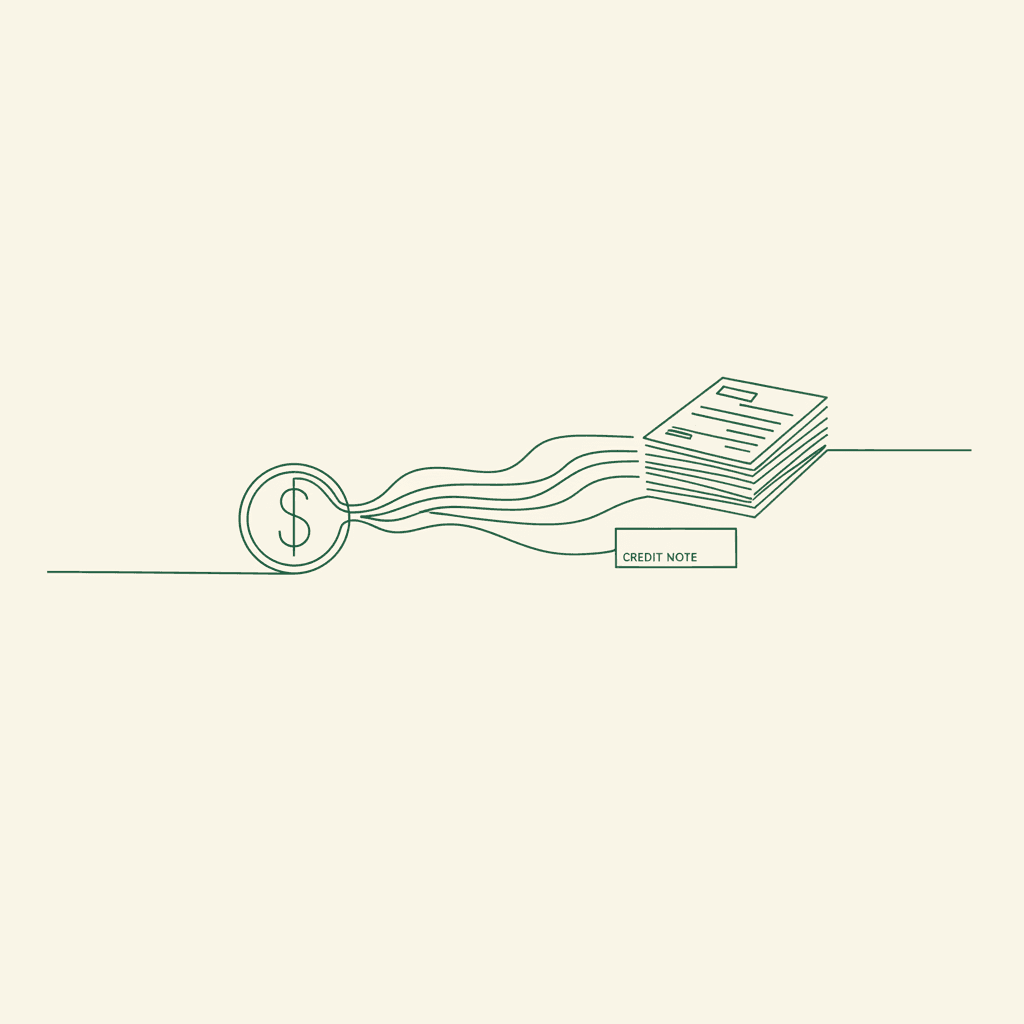
 A single payment stream splitting cleanly toward several invoice documents
Why do retailers send partial or bundled payments on wholesale invoices?
Nordic wholesale retailers and wider EU distributors often pay on their own cycle, not invoice-by-invoice. Common patterns include:
- Bundled payment — one transfer covering several invoices from different order dates or warehouses.
- Partial settlement — cash for part of an invoice while a dispute, shortage, or return is open.
- Net of credit notes — payment reduced by approved returns or price corrections already issued.
- Net of deductions — chargebacks, marketing agreements, logistics claims, or short-pays taken at source.
- Early-pay behaviour — payment inside discount terms, or a claimed discount that still needs checking against B2B net payment terms.
Remittance advice (email, portal file, or e-invoice payment reference fields) is the map. Without it, finance is guessing which open items the retailer meant to clear. That guesswork is what turns a routine receipt into a reconciliation project.
When should early-payment discounts, chargebacks, or deductions be split out first?
Always separate non-cash reductions from cash before you allocate the bank amount. Treat the receipt as layers:
- Identify claimed early-payment discount — confirm it matches agreed terms and invoice dates; post discount to the right income or adjustment account, not as mystery underpayment.
- Identify chargebacks and deductions — route disputed amounts to a deductions or claims workflow rather than silently writing down the invoice.
- Apply approved credit notes — match credit notes to the invoices or account balance they belong to.
- Allocate remaining cash — only then spread the true cash across open invoices.
If you apply the full bank line as “payment” and only later notice a discount or chargeback, you create false residuals and hide margin leakage. Teams that run wholesale early payment discounts and a clear chargebacks and deductions process recover faster because the allocation step is not where commercial exceptions are invented.
 Stacked layers of discount, credit note, and cash being separated before matching
How should finance apply a partial payment across multiple open invoices?
Start from documents the customer named, not from “oldest first” alone—unless your written policy says FIFO when remittance is missing.
Practical sequence
- Match remittance lines to invoice numbers (and credit notes) on the customer ledger.
- Confirm currency and full invoice totals including VAT where the invoice is VAT-inclusive; multi-currency catalogues make FX differences a separate residual, not something to bury inside allocation.
- Apply cash line by line until each referenced invoice is paid in full or intentionally left with a residual open item.
- Leave unexplained shortfall open (or park on a suspense/deduction code with an owner)—do not force a full clear if the retailer underpaid.
- Post overpayment as unallocated cash or on-account only after named invoices are satisfied, with a rule for how on-account is later cleared.
Prefer explicit invoice references over dumping the receipt as a single on-account balance. On-account posts are sometimes necessary; they are not a substitute for allocation when remittance exists. This discipline is the backbone of reliable wholesale invoice reconciliation.
| Situation | Prefer | Avoid |
|---|---|---|
| Remittance lists invoice numbers | Line-level allocation to those open items | Single on-account dump |
| Partial pay on one invoice | Cash + residual open item on same invoice | Closing the invoice and creating a random credit |
| Bundle across many invoices | Pay in listed order; residual on last underpaid item | Spreading evenly “to make it tidy” |
| Missing remittance | Policy default (e.g. oldest due first) + chase advice | Silent write-off of differences |
How do you allocate payments when credit notes sit against the same account?
Credit notes are open items too. Allocation should net them deliberately:
- Linked credit — if the credit note references a returns or price-correction invoice, apply it against that invoice (or the residual) before or with the cash.
- Unallocated credit on account — apply to the invoices the retailer names; if they do not name any, follow policy (oldest open, or hold until advice arrives).
- Credit larger than remaining cash need — clear the named invoices and leave residual credit open; do not create a fake payable to the customer without a process.
The customer ledger should still explain itself after posting: each invoice and credit note either closed with a clear combination of cash, credit, discount, and deduction—or left open with a residual that credit control can chase. Mixing credit notes into cash as an undocumented net is how open items drift from the order-to-invoice trail.
How do Fortnox open items behave with partial and multi-invoice payments?
In Fortnox, customer invoices and related payments are handled through the customer invoicing and payments workflow (open receivables on the customer side).[1] A partial payment should reduce the open amount on the specific invoice(s) you select: when the amount paid is less than the invoice balance, the invoice is registered as partially paid, its balance changes, and it remains in the unpaid invoice list—rather than merely moving cash to the customer without document links.[1] Multi-invoice receipts need explicit distribution so each invoice’s remaining open item is correct for statements, dunning, and period close.
What usually goes wrong in wholesale stacks:
- Payment booked only at customer level, leaving invoices fully open while the account shows unallocated cash.
- Full close of an invoice when only part of the amount was received.
- Credit notes left floating while cash is applied elsewhere, so net exposure looks wrong.
- Manual re-keying from portal orders, spreadsheets, and bank files so invoice numbers in Fortnox no longer match what the retailer paid against.
A clean order-to-invoice trail—and Fortnox wholesale accounting sync from the commercial system—reduces remittance re-keying because invoice identities, VAT treatment, and balances already match what finance sees in the ledger. Brands that keep ordering on email and spreadsheets spend more time reconstructing which shipment became which open item before they can allocate at all.
 A ledger book with open invoice lines being checked off by one payment quill
What breaks order-to-cash if partial payments are posted incorrectly?
Order-to-cash (and the narrower invoice-to-cash leg) depends on a continuous chain: order → fulfilment → invoice → open item → allocation → closed item. Incorrect partial posts break that chain in predictable ways:
- Credit control chases the wrong balance — invoices show fully open though cash arrived, or show closed though residual is still owed.
- Statements confuse retailers — especially when bundled payments and credit notes are common.
- Disputes multiply — without a document-level audit trail, sales and finance argue from different numbers.
- Period-end AR does not tie — unallocated cash, negative open items, and suspense accounts pile up.
- Automation stalls — order-to-invoice automation only helps cash application if the invoice side remains the system of record for what was billed.
Partial payment allocation is not a back-office nicety; it is how wholesale keeps commercial promises and ledger truth in the same place.
What rules and audit trail should wholesale teams document for allocation?
Write a short allocation policy that finance and credit control actually use:
- Remittance first — require invoice-level advice for bundled retailer payments where possible; define the fallback order when advice is missing.
- Exception order — discounts, chargebacks, credits, then cash.
- Residual handling — when to leave open items, when to use deduction codes, when write-off needs approval.
- On-account limits — who may leave unallocated cash and how quickly it must be cleared.
- Multi-currency — how FX differences are posted so they are not mistaken for underpayment.
- Audit trail — store remittance file or message id, allocator, timestamp, invoice references, and reason codes for deductions or write-offs.
- Segregation — payment posting vs write-off approval where team size allows.
For Nordic wholesale brands on Fortnox, the same rules should hold whether cash is applied in the ERP or proposed from a B2B portal workflow: the open items that remain must still be the invoices the business would defend on a statement. A branded distributor portal with a reliable invoice history does not replace allocation judgement, but it gives finance fewer mismatched references to repair—time better spent on true disputes than on re-typing remittances.
If your team is still matching bundled payments from inboxes and spreadsheets, tighten the document trail first; tools help most when invoice identity is already stable. Book a demo if you want to see how Brandgate keeps order-to-invoice data aligned with Fortnox-oriented wholesale finance workflows—or see pricing when you are comparing options.
 A continuous paper trail from order slip through invoice to stamped receipt