TL;DR
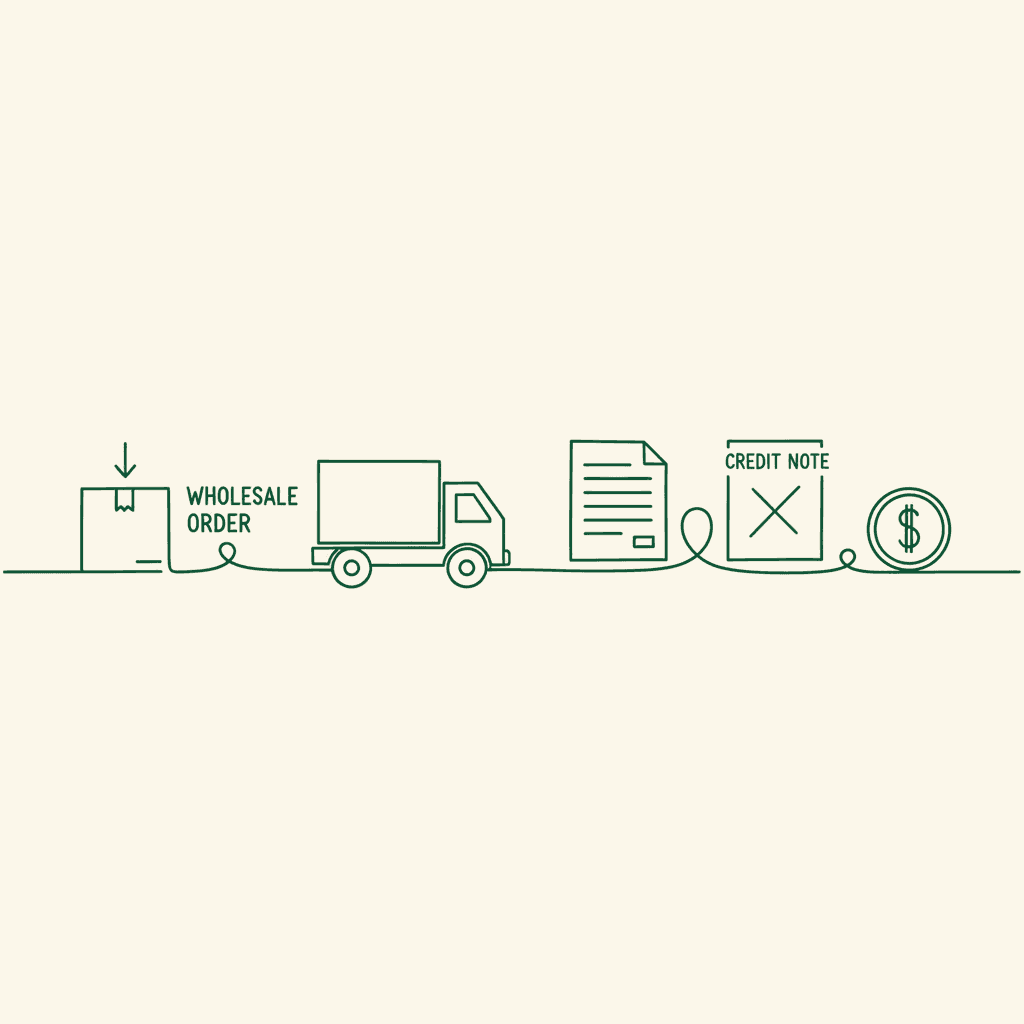
Wholesale invoice reconciliation works best when it is treated as an order-to-cash control, rather than a last-minute finance task. The aim is simple: each amount in accounts receivable should be traceable to an agreed order, a delivery event, an invoice or credit note, and eventually a payment.
That sounds straightforward. It becomes difficult when a wholesale brand or wholesale distributor keeps orders in email, delivery evidence in another system, invoice details in accounting software, and payment references in a bank feed. The resulting gaps are where disputes, delayed collections and unexplained balances tend to accumulate.
What is wholesale invoice reconciliation?
Wholesale invoice reconciliation is the process of checking that a retailer's order, the goods delivered, the invoice issued, any credit note, and the payment received agree—or that every difference is documented and resolved.
It is part of order-to-cash reconciliation, the set of checks that follows a sale from order acceptance through fulfilment, billing, collection and accounting. For wholesale accounts receivable, reconciliation gives finance a defensible answer to two practical questions:
- What does each retailer owe right now?
- Why does the balance differ from the original order, if it does?
A useful distinction is between the commercial documents and the accounting documents:
| Record | What it establishes | Reconciliation use |
|---|---|---|
| Sales order | What the retailer requested and what was approved | Starting point for products, price, terms and destination |
| Order confirmation | What the supplier accepted | Confirms the agreed commercial version of the order |
| Delivery note | What left the warehouse or was handed to the carrier | Evidence for the shipped or delivered quantity |
| Invoice | What the customer is being asked to pay | Receivable to be collected and posted |
| Credit note | A reduction or correction of a previous charge | Offsets the original invoice or its remaining balance |
| Payment | Cash received from the customer | Must be allocated to the right invoice or account balance |
A pro forma invoice is a preliminary commercial document, often used before the final tax invoice or payment step. It should not be confused with the final invoice when reconciling accounts receivable.
 A set of order papers, a parcel and a coin connected by one continuous looping line
How do you reconcile wholesale orders, deliveries, invoices and payments?
Start with a defined matching sequence. The right detail level depends on your product range and trading terms, but the process should be consistent across customers.
1. Confirm the approved sales order
Use the sales order and order confirmation as the commercial baseline. Check the retailer account, ship-to location, SKUs, agreed price list or discount, quantities, delivery terms, currency, payment terms and any approved changes.
This step is much easier when retailer onboarding creates a clean customer record from the outset. Duplicate accounts, incomplete addresses and unrecorded payment terms often become reconciliation problems later.
2. Match the invoice to what was fulfilled
Compare invoice lines with the delivery note, dispatch confirmation or other fulfilment record. This is commonly called three-way matching: comparing the order, evidence of fulfilment and invoice.
For physical goods, match at line level where practical:
- SKU or product description
- ordered quantity
- delivered quantity
- unit price and discount
- freight or other agreed charges
- tax treatment
- invoice currency
Do not assume the original order quantity is the invoice quantity. A partial shipment, substitution, shortage or cancelled line may be legitimate. The key is that the invoice follows the agreed billing rule and the difference is visible.
3. Check invoice status and posting
Confirm that the invoice has a unique reference, correct customer account, due date and status. Ensure that it is not duplicated, cancelled, replaced or already offset by a credit note.
Keep a clear link from the invoice back to the sales order and fulfilment records. A shared reference is helpful, but a reliable record relationship is better than relying on someone remembering an email thread.
4. Allocate cash to the correct receivable
Invoice payment matching is the task of applying a received payment to the relevant invoice, or recording why it cannot yet be applied. Match using the payment reference, payer name, currency, amount, remittance advice and invoice number where available.
When a retailer pays several invoices in one transfer, allocate the payment across the listed invoices. When a payment is short, do not quietly close the invoice: leave the remaining amount open and raise an exception with supporting detail.
For credit-managed accounts, this work should feed directly into the team's approach to wholesale credit control. A current receivables ledger is essential for sensible collection decisions.
Which exception types should wholesale finance teams investigate?
Exceptions are not failures by default. They are differences between records that need a reason, an owner and a resolution path. A useful exception queue prevents finance staff from repeatedly searching across inboxes, warehouse systems and spreadsheets.
Common wholesale invoice matching exceptions include:
- Quantity variance: the delivered quantity differs from the sales order or invoice.
- Partial shipment: only part of the order shipped and the remainder is expected later.
- Backorder: the unsupplied balance remains open for a later fulfilment decision.
- Price variance: the invoice does not reflect the accepted price, discount or campaign terms.
- Duplicate billing: the same shipment or order line appears on more than one invoice.
- Unbilled delivery: goods have shipped but no invoice has been raised.
- Invoice without fulfilment evidence: an invoice exists but the delivery record is missing or unclear.
- Short or overpayment: the cash received does not equal the invoice balance.
- Unapplied payment: cash has arrived but cannot be confidently assigned.
- Customer master-data issue: the payer, retailer entity, billing address or currency is wrong.
Set a simple workflow for each exception: record the reference, identify the reason, assign an owner, choose the corrective document or action, and retain the outcome. Sales should own commercial approvals; warehouse or operations should verify fulfilment; finance should control invoice status, credit notes and payment allocation.
 A warehouse shelf, delivery box and invoice folder arranged as a clear connected workflow
How should you reconcile credit notes, returns and short shipments?
A credit note is a document that reduces all or part of an amount previously invoiced. Credit note reconciliation means proving which invoice and which original charge the credit relates to, then ensuring the customer balance is reduced once—not twice.
For returns, begin with a return authorization (RMA). An RMA is an approved reference for goods a customer is permitted to send back. It should identify the original order or invoice, products, quantities, reason for return and the proposed commercial outcome.
A controlled returns flow normally follows this sequence:
- Approve the RMA under the agreed returns policy.
- Record receipt and inspection of returned goods where applicable.
- Confirm the accepted quantity and reason code.
- Issue a credit note only for the approved amount.
- Link the credit note to the original invoice and allocate it against the balance, refund or future order according to your policy.
Short shipments should be handled with equal clarity. If the retailer was invoiced for more than was delivered, issue or approve the correction promptly. If the retailer was invoiced only for goods shipped, retain the remaining sales-order balance as a backorder or close it with a documented reason.
A defined wholesale returns and credit note process keeps customer service, warehouse staff and finance working from the same evidence.
How do VAT, currencies and payment differences affect reconciliation?
Tax and currency differences can make a commercially correct invoice look different from the original order total. They should be controlled as explicit fields and documented rules, not adjusted informally during month end.
For VAT, validate the customer identity, billing and delivery information, tax treatment, invoice fields and supporting evidence required by your business policy and the relevant jurisdictions. Cross-border B2B transactions need particular care because the appropriate treatment depends on the facts of the supply. Keep the records that explain why a treatment was used, and review your process against current EU VAT compliance for B2B wholesale guidance and professional advice.
For currency, establish which currency governs the order, invoice and settlement. A multi-currency catalogue can make retailer ordering clearer, but finance still needs a documented policy for recording the invoice, handling bank charges and identifying differences between invoiced and settled amounts.
Do not let small differences become invisible write-offs. Record whether a variance relates to an agreed discount, a credit note, a payment fee, an exchange-related difference or an unresolved dispute. The correct accounting treatment should follow the company's accounting policy.
What should a month-end wholesale invoice reconciliation checklist include?
Month-end should confirm that the ledger reflects the operational state of wholesale trading. It should not be the first time anyone notices that goods shipped without an invoice or that a retailer has disputed a balance.
Use a repeatable month-end close checklist:
- Review sales orders that are open, cancelled, partially shipped or on backorder.
- Identify deliveries completed before the reporting cut-off that remain uninvoiced.
- Identify invoices raised without linked fulfilment evidence and investigate them.
- Reconcile open accounts receivable to the invoice register and payment allocations.
- Review unapplied cash, short payments, overpayments and customer deductions.
- Reconcile credit notes to their source invoices, returns or approved commercial adjustments.
- Review invoices due or overdue with sales and credit-control owners.
- Check that currency, tax and customer-master-data exceptions have a documented resolution.
- Preserve the reconciliation report, exception log and approvals for review.
The exact cut-off rules, approval thresholds and tolerance handling should come from your own accounting policy and adviser guidance. Consistency matters more than adopting a generic rule that does not fit your trading model.
Can order-to-invoice automation improve wholesale reconciliation?
Yes—order-to-invoice automation can improve reconciliation by keeping order, fulfilment, invoice and customer records connected, so exceptions are easier to identify and trace.
Automation does not remove the need for review. It reduces the re-keying that creates avoidable mismatches, while giving people a clearer audit trail for genuine commercial exceptions. The strongest workflows preserve the source references as an order moves through approval, shipping, invoicing and payment collection.
For example, a branded B2B distributor portal can capture an approved retailer order against the right account, price list, currency and terms. Order-status visibility can show whether a line is awaiting fulfilment, partially shipped or complete. VAT-aware invoicing and structured data transfer to accounting can then make the final invoice easier to reconcile with the original transaction.
Brandgate supports this connected approach with a branded B2B storefront, retailer onboarding, multi-currency catalogues, VAT-aware invoicing and order-to-invoice workflows, including native Fortnox integration. Read more about order-to-invoice automation for wholesale and Fortnox accounting sync for wholesale.
 A branded wholesale storefront flowing into a parcel, invoice and accounting ledger
When should a wholesale business replace spreadsheets with integrated systems?
Spreadsheets can work for a small, stable order flow when one person can see the full history of each transaction. They become fragile when several teams edit records, retailers order across currencies, shipments split, credit notes rise, or finance must repeatedly re-enter data between sales and accounting tools.
Consider an integrated system when the team is regularly asking questions that should have a quick, reliable answer:
- Which orders are approved but not yet shipped?
- Which deliveries are awaiting invoicing?
- Which invoice relates to this retailer payment?
- Is this credit note tied to a return, a shortage or a pricing correction?
- Which version of the order is the approved one?
The goal is not automation for its own sake. It is a controlled order-to-invoice process where each team works from the same transaction history and spends its time resolving meaningful exceptions.
If you are reviewing how your wholesale orders, invoicing and Fortnox workflows connect, book a demo to discuss the process. You can also see pricing when you are ready to compare options.