TL;DR
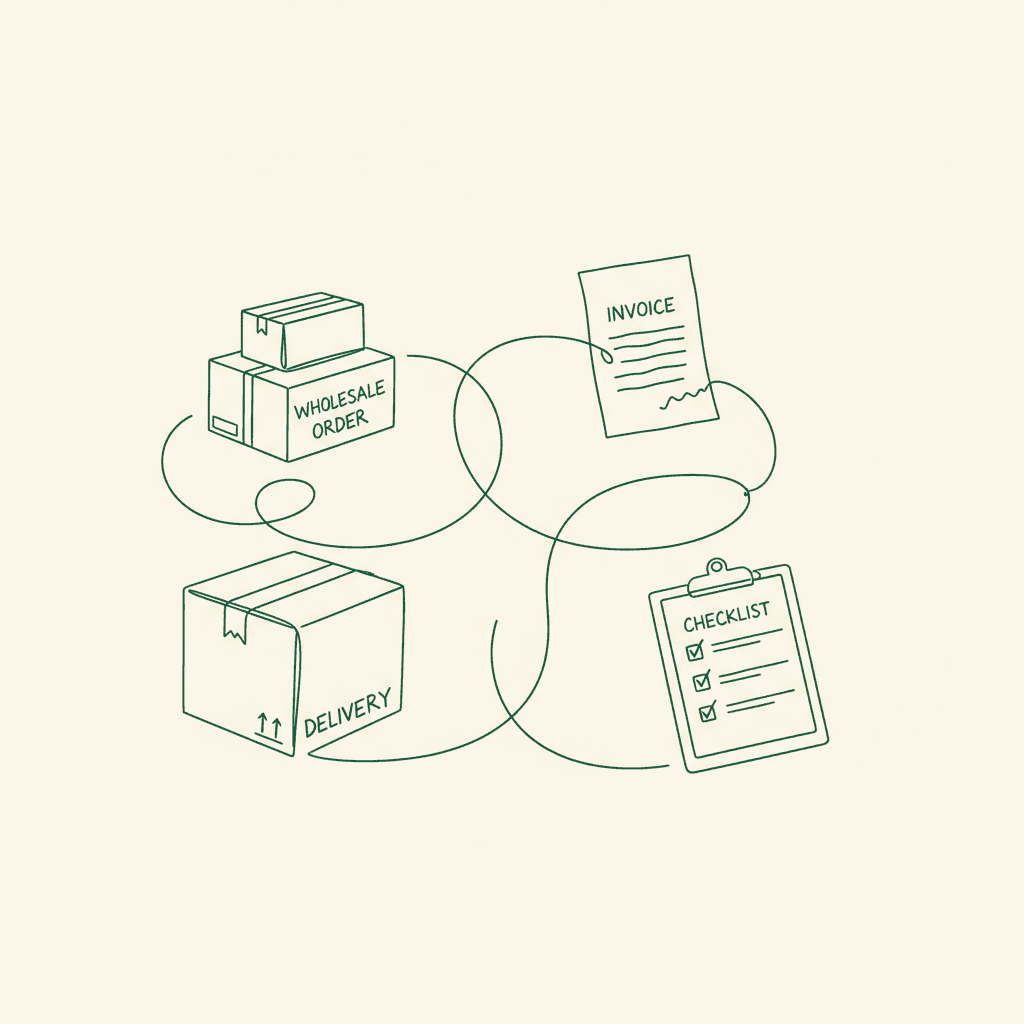
A wholesale order confirmation email is the seller’s written record of the order it believes has been agreed with a retailer or distributor. It is the point at which an informal purchase order, call or portal order becomes a clear operational instruction for everyone involved.
Use it to confirm the exact products, commercial terms and fulfilment plan—not simply to say “order received.” The recipient should be able to check the order without searching through earlier emails or attachments.
What is a wholesale order confirmation email?
A wholesale order confirmation email is a message sent by the supplier after reviewing an order and confirming the products, prices, availability and terms it plans to fulfil. It is often called a B2B order acknowledgement, especially when it acknowledges receipt before stock, credit or pricing checks are complete.
The distinction matters. A purchase order is the buyer’s request to buy. A sales order is the seller’s internal record of the order. The confirmation communicates the seller’s accepted version of that order back to the buyer.
A useful confirmation makes changes visible. If the buyer requested 20 cases but only 15 are available, the document should state that plainly rather than leaving the buyer to infer it from a revised quantity.
 A retailer and supplier reviewing a neatly arranged order sheet beside stacked parcels
What should a wholesale order confirmation email include?
A wholesale order confirmation email should include enough detail for the buyer to validate the order, for the warehouse to fulfil it and for finance to understand the commercial basis of the sale.
Use this checklist for the email body or a linked PDF confirmation.
Wholesale order confirmation checklist
- Order reference: Your sales order number, order date and the buyer’s purchase order reference.
- Seller and buyer details: Legal or trading names, primary contacts and billing details where needed.
- Ship-to details: Recipient name, delivery address, delivery contact and any receiving instructions.
- Product lines: SKU, product name, variant, pack size or case pack, confirmed quantity and unit of measure.
- Pricing: Unit price, line total, any wholesale discount, subtotal and the transaction currency.
- Tax treatment: VAT amount or VAT treatment, stated clearly and consistently with the transaction.
- Delivery terms: Shipping method, requested delivery date, confirmed shipping date or delivery window, and Incoterms where relevant.
- Availability exceptions: Backordered products, approved substitutions, discontinued lines or planned partial shipments.
- Payment terms: Due date basis, payment method, credit status if relevant, and the applicable payment terms.
- Next steps: What the buyer needs to approve, when they should report discrepancies and whom to contact.
For products with many sizes, colours or formats, the product table is the highest-risk part of the message. In this guide, use a SKU to identify the sellable item, a variant to identify its particular version—such as colour or size—and a case pack to state the units supplied per case.
Use the same names, SKUs and pack logic that appear in your catalogue and warehouse process. This avoids the common situation where sales confirms “blue bottles” while fulfilment needs a specific SKU and case quantity. See this guide to wholesale SKU management, variants and case packs for a practical way to keep those details consistent.
How should you structure a B2B order acknowledgement?
Structure a B2B order acknowledgement so the buyer can scan the headline status first, verify the order lines second and find exceptions and actions last.
A plain-text email works for straightforward repeat orders. For larger orders, attach or link to a formatted confirmation that preserves the line-level detail. Either way, use a predictable sequence.
Copy-ready wholesale order email template
Subject: Order confirmation [your order number] — [buyer name]
Hello [buyer contact],
Thank you for your order. We confirm the following order based on purchase order [buyer PO number]. Please review the product, delivery and payment details below and contact us by [date or instruction] if anything needs correcting.
Order summary
| Field | Confirmed detail |
|---|---|
| Seller order number | [Sales order number] |
| Buyer | [Retailer or distributor name] |
| Buyer PO reference | [PO number] |
| Billing contact | [Name and email] |
| Delivery contact and address | [Name, phone, full address] |
| Currency | [Currency] |
| Delivery terms | [Shipping method and Incoterm, if applicable] |
| Shipping date or delivery window | [Date or window] |
| Payment terms | [Terms and payment instructions] |
Confirmed products
| SKU | Product / variant | Case pack | Confirmed quantity | Unit price | Discount | Line total |
|---|---|---|---|---|---|---|
| [SKU] | [Product and variant] | [Pack] | [Qty] | [Price] | [Discount] | [Total] |
| [SKU] | [Product and variant] | [Pack] | [Qty] | [Price] | [Discount] | [Total] |
Totals and VAT
- Subtotal: [amount and currency]
- VAT treatment: [rate, amount or applicable treatment]
- Order total: [amount and currency]
Availability and delivery notes
- [State any backorder, substitution, allocation or partial-shipment detail.]
- [State what will happen next and when.]
Kind regards,
[Name]
[Company]
[Contact details]
The template is deliberately direct. Avoid vague wording such as “delivery soon” or “prices as discussed.” State the relevant date, currency and agreed commercial term instead.
How should VAT, prices and discounts appear in a wholesale order confirmation?
Show the buyer the commercial calculation in the currency they are buying in. Each product line should make clear whether the quantity is units, cases, cartons or another unit of measure. It should also show the unit price, any discount and the resulting line total.
The subtotal is the value of the order lines before VAT and any separately stated charges. If freight, deposits or other charges apply, list them separately rather than hiding them in a line price.
Describe VAT treatment carefully. Set out the VAT rate, amount or applicable treatment in a way that matches the transaction, and have your finance team or adviser validate it where needed. Our guide to EU VAT compliance for B2B wholesale covers the operational questions teams should resolve before invoicing.
Do not rely on a discount percentage alone. Where possible, show both the discount and the resulting net unit price. That gives the buyer a practical basis for checking customer-specific pricing and prevents misunderstandings when prices are maintained in different currencies.
 A set of product cartons, currency coins and a simple receipt arranged on a clean desk
What delivery details should you confirm with a retailer or distributor?
Confirm the delivery address, contact, shipping method and realistic shipping date or delivery window. If the delivery arrangement includes an Incoterm, state the agreed rule and named place precisely, rather than using an abbreviation without context.
Incoterms® rules define seller and buyer responsibilities for aspects of delivery, including tasks, costs and risks. [2]
Where the buyer gives a requested delivery date, distinguish it from the date you have actually confirmed. A requested date is a preference; a confirmed date or delivery window is the supplier’s operational commitment, subject to the terms of sale.
How should you communicate backorders, substitutions and partial shipments?
Put every exception in a dedicated section below the order totals and repeat it near the affected line item if the order is complex. A buyer should not have to compare two versions of a spreadsheet to discover that an item is missing.
For each exception, state:
- the SKU and variant affected;
- the quantity confirmed now and the quantity outstanding;
- the expected availability or review point, if known;
- whether a substitution has been proposed or approved; and
- whether the order will ship in full or as a partial shipment.
Do not substitute a product merely because it looks similar. Confirm the replacement SKU, price, pack size and any effect on delivery before processing it, unless your contract clearly permits a defined substitution process. A documented approach to practical wholesale backorder management helps teams give buyers consistent updates.
 A delivery route splitting into an arriving parcel and a carefully held backorder parcel
What payment terms and next steps belong in the confirmation email?
State the agreed payment terms in terms the buyer can act on: for example, the payment due basis, payment method and any instruction required before dispatch. Keep payment terms consistent with the account agreement and any approved credit process.
The next step should reflect the actual order status. If the order is fully accepted, ask the buyer to flag discrepancies promptly. If it is pending a credit review, stock allocation or buyer approval, say so clearly and avoid language that implies final acceptance.
For accounts on credit, a consistent confirmation is also a useful control point. It makes the buyer’s PO reference, agreed price and payment expectation accessible before goods leave the warehouse. See wholesale credit control and payment terms for the wider process around setting and managing those terms.
Can a wholesale order confirmation email replace an invoice?
No. An order confirmation records what the seller believes has been agreed; it is not automatically a VAT invoice. [1]
VAT invoicing rules set mandatory invoice content, and invoicing obligations depend on the applicable transaction and rules. An order confirmation should be treated as an invoice only where it meets the requirements that apply to that transaction. [1]
The documents serve different moments in the workflow:
| Document | Primary purpose | Typical timing | What it should make clear |
|---|---|---|---|
| Order confirmation | Confirms the accepted order | After review or acceptance | Products, prices, availability, delivery plan and terms |
| Dispatch notice | Tells the buyer goods are on their way | When goods are dispatched | What shipped, quantities, carrier and tracking or delivery information |
| Invoice | Supports billing under the agreed invoicing process | According to the agreed invoicing process | Amount due, payment details and required invoicing information |
A dispatch notice is also not a substitute for an order confirmation. It reports fulfilment activity; it does not necessarily show the original agreed price, payment terms or treatment of unshipped lines.
How can wholesale brands make order confirmations more reliable?
Reliability comes from using one controlled order record rather than rebuilding the same order in email, spreadsheets, warehouse notes and accounting software. Agree who can approve pricing, stock exceptions and delivery changes, then make that record the source for each customer-facing document.
A branded B2B storefront can capture the buyer’s selected SKUs, quantities, currency and delivery details at the point of ordering. A connected order-to-invoice workflow can then carry approved order information forward, reducing the need to re-key it across teams.
Brandgate supports this approach with a branded distributor portal, multi-currency catalogues, VAT-aware invoicing and Fortnox sync for wholesale teams that want a clearer order-to-invoice workflow. The goal is not to send more email; it is to ensure the email, sales order and invoice reflect the same approved information. Learn more about wholesale order-to-invoice automation.
If your confirmations still depend on copied email threads and manual checks, Book a demo to see how Brandgate can support a more consistent wholesale order process.