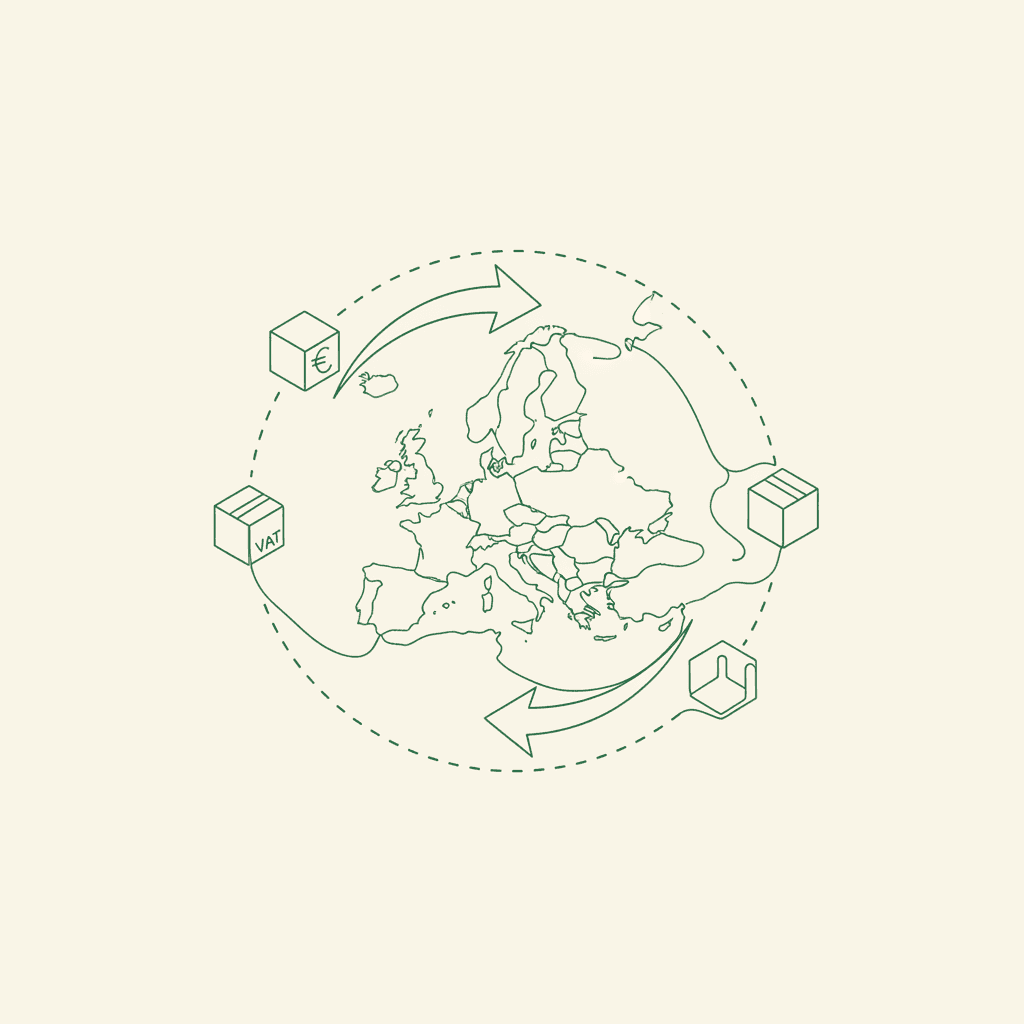
Running wholesale across EU borders means dealing with Value Added Tax rules that differ sharply from domestic sales. Get it wrong and you face penalties, rejected invoices, and costly retrospective corrections. Get it right and cross-border B2B transactions flow smoothly with minimal administrative friction.
EU VAT compliance for B2B wholesale hinges on understanding which transactions qualify for exemption, when the reverse charge applies, and what documentation you must maintain. This guide walks through the mechanics, the requirements, and the practical steps to stay compliant.
What is EU VAT compliance for B2B wholesale?
EU VAT compliance for B2B wholesale is the process of correctly applying Value Added Tax rules to business-to-business transactions across European Union member states. Unlike consumer sales, B2B wholesale within the EU Single Market operates under special rules designed to avoid double taxation and simplify cross-border trade.
A taxable person — any business registered for VAT — selling goods to another taxable person in a different EU country typically benefits from the reverse charge mechanism.[1] This shifts the VAT liability from the seller to the buyer, meaning the seller invoices without charging VAT and the buyer accounts for it in their own jurisdiction.[1] The transaction is treated as an intra-community supply (ICS) for the seller and an intra-community acquisition (ICA) for the buyer.
For this system to work, both parties must hold valid VAT identification numbers, the goods must physically move between member states, and the seller must maintain proof of dispatch or transport. When these conditions are met, the supply is VAT-exempt in the seller's country and taxed in the buyer's country under the reverse charge.[1]
 A parcel crossing a bridge between two simplified building icons representing different countries
How does the reverse charge mechanism work in EU B2B wholesale?
The reverse charge mechanism is the cornerstone of intra-EU B2B VAT treatment.[1] Under this rule, the supplier does not charge VAT on the invoice. Instead, the buyer self-accounts for VAT in their own member state at the applicable local rate.
Here's the flow: A Swedish brand sells goods to a German distributor. The Swedish supplier invoices the German buyer without Swedish VAT.