Nordic wholesale brands increasingly meet buyers who will not process PDF invoices by hand. Peppol e-invoicing wholesale is the practical answer: structured invoices travel over a shared network with agreed semantics, so finance systems can post them with far less re-keying. This guide explains what Peppol is, how it sits in order-to-invoice, which master data you need, and where setup usually goes wrong—without treating e-invoicing as a pure compliance checkbox.
What is Peppol e-invoicing wholesale and how does it work?
Peppol e-invoicing wholesale is the use of the Peppol network to send and receive structured electronic invoices between a brand or distributor and its B2B buyers (retailers, resellers, public bodies) using agreed document specifications.
Peppol is a set of technical specifications and a four-corner trust model. Suppliers and buyers each connect through a Peppol Access Point. Messages are routed using participant identifiers.[1] For invoices, the common profile in Europe is Peppol BIS Billing 3.0, aligned with the European semantic standard EN 16931.[2] An e-invoice in this sense is machine-readable XML with defined business terms—not a PDF attached to email, even if the PDF looks “official.”
In wholesale, that structure must carry party details, VAT treatment, currency, order references, and line items that match how you actually sell (SKU, case pack, unit of measure). The network moves the document; your catalogue and customer data decide whether the buyer’s system can auto-post it.
 Abstract network nodes exchanging a structured invoice document
Who must send or receive Peppol invoices in Sweden and the Nordics?
Obligations differ by country, sector, and buyer—not by a single Nordic rulebook. In Sweden, public-sector e-invoicing is implemented with Peppol as the established channel: Digg (the Agency for Digital Government) steers the national approach and recommends Peppol BIS Billing 3 for compliance with the European e-invoicing standard, and Skatteverket provides tax-side guidance on invoicing rules that still apply regardless of format.[3][4][5] Neighbouring Nordic markets have their own Peppol or aligned e-invoicing programmes for public procurement and, increasingly, large private chains.
For many private B2B wholesalers the driver is commercial, not a blanket law: key retailers, grocery/pharmacy groups, and public-affiliated buyers mandate Peppol endpoints and reject email PDFs. Cross-border EU B2B adds buyer-specific requirements on top of VAT invoicing rules. Treat “must we?” as a portfolio question: map which accounts require Peppol receipt, which formats they accept, and what identifiers they publish—then confirm current rules with official sources and your Access Point provider rather than assuming one Nordic mandate covers every invoice.
How does Peppol fit into a wholesale order-to-invoice flow?
Peppol sits at the invoice handoff, not at first basket creation. A clean wholesale flow looks like this:
- Retailer or distributor is onboarded with verified legal entity, VAT ID, Peppol participant ID / GLN where used, and bill-to / ship-to parties.
- Orders are captured in a branded portal or sales process against a structured catalogue (prices, units, GTINs if you use them).
- Fulfilment confirms deliverable quantities and any partials or substitutions your terms allow.
- The invoice is generated from the same order and party master—tax codes, currency, and references included.
- Your billing stack or ERP emits BIS Billing content via a Peppol Access Point to the buyer’s Access Point.
If step 1–3 are messy, Peppol only accelerates bad data to the buyer’s AP team. That is why Peppol readiness is inseparable from order-to-invoice automation for wholesale: the e-invoice should be a structured projection of an already consistent order, not a re-typed finance document.
 Order box transforming into a structured e-invoice along one continuous path
What customer master data do you need for Peppol e-invoicing?
Peppol rejects guesswork at the party level. For each bill-to customer you typically need:
- Legal name and address consistent with the buyer’s registration
- VAT identification number (and correct country context for intra-EU supplies)
- Peppol participant identifier as registered in the network
- GLN (Global Location Number) when the buyer or your sector uses GLNs for ordering/invoice endpoints or ship-to locations[6]
- Bill-to versus ship-to versus sold-to distinctions when they differ
- Invoice delivery preference (Peppol endpoint as primary; PDF only as fallback if contractually allowed)
- Payment terms, currency, and any buyer-specific order/invoice reference rules
Wholesale teams that keep this in spreadsheets see repeated endpoint failures and tax-field rejects. Investing in B2B customer master data for wholesale teams pays off before you touch Access Point configuration. Validate EU VAT numbers through disciplined process (including VIES VAT number validation where applicable) so EN 16931 tax total and party VAT fields are not improvised at invoice time.
Catalogue master data matters equally: unit of measure, prices in the invoice currency, and line identifiers must match what the buyer ordered. Mismatched case vs piece units are a classic wholesale reject cause even when the network transmission succeeds.
 Clean buyer identity card with abstract ID marks beside a catalogue tile
How do Peppol e-invoices tie into accounting systems without manual re-keying?
The point of structured e-invoicing is straight-through posting. Your ERP or accounting system should either:
- generate EN 16931 / BIS Billing content natively and hand it to an Access Point, or
- pass a complete invoice payload to a service that maps and transmits it,
…and on the receive side, import supplier invoices into purchase ledgers without typing totals from PDFs.
For Nordic brands already on modern bookkeeping tools, the integration pattern is usually: wholesale orders and invoices created upstream → accounting system remains system of record for books → Access Point handles network transport and delivery receipts. Manual re-keying disappears only if product codes, VAT rates, and dimensions on the invoice match the accounts you already use. Peppol does not fix chart-of-accounts design; it exposes it.
Operationally, monitor delivery status from the Access Point, quarantine semantic validation errors, and reconcile failures against the original order ID—not against an email thread. That closes the loop between sales operations and finance.
What are the most common Peppol setup mistakes for wholesale brands?
Wholesale Peppol projects fail for predictable reasons:
- Wrong or stale participant IDs — buyer changed Access Point or GLN; master data never updated
- PDF habits retained — dual-sending unstructured copies that buyers ignore while waiting for the real e-invoice
- Tax and party fields incomplete — missing VAT IDs, incorrect reverse-charge or intra-EU indicators, or bill-to party not the legal contracting entity
- Line semantics drift — free-text descriptions, unit mismatches, or prices that do not match the contract price list
- Order references omitted — buyer AP cannot match invoice to PO, so “structured” still means manual work
- IT-only ownership — finance, sales ops, and master-data owners never agree who maintains endpoints
- Big-bang onboarding — every customer on day one instead of prioritising Peppol-mandatory accounts
Fix the data model and ownership first; transmission second.
How does Peppol relate to EDI, PDF invoices, and cross-border EU B2B?
E-invoice vs PDF: a PDF is a human-readable picture of an invoice. Peppol BIS Billing is structured data with agreed meaning. Many buyers still archive a human view, but process automation depends on the structured payload.
EDI: classic EDI for wholesale B2B brands often means bilateral mappings (orders, ASNs, invoices) per retailer. Peppol standardises invoice (and related) semantics across many counterparties through Access Points. Some retailers still require broader EDI message sets; Peppol invoices may coexist with EDI orders rather than replace every message type overnight.
Cross-border EU B2B: Peppol helps delivery of a structured invoice across borders when both parties are reachable on the network, but VAT content must still follow the supply’s tax rules. Pair Peppol work with solid EU VAT compliance for B2B wholesale—identifiers, place-of-supply logic, and invoice content—so the document is both routable and taxable-correct.
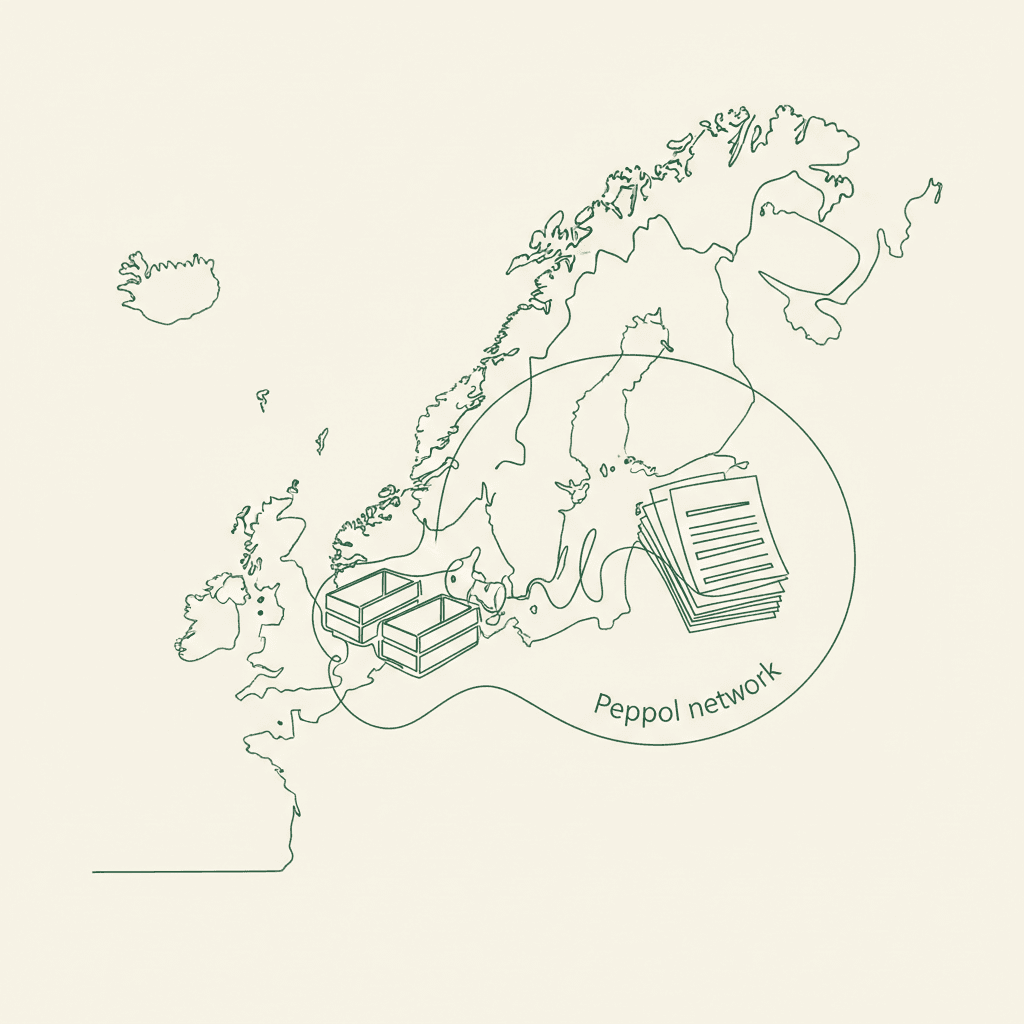
 Simplified Europe map with abstract invoice routes between hubs
When should a Nordic wholesale brand prioritise Peppol readiness?
Prioritise when any of these are true:
- Strategic retailers or public buyers state Peppol-only AP intake
- Finance is buried in PDF re-keying and invoice disputes tied to missing PO references
- You are expanding cross-border EU wholesale and buyers ask for network e-invoices at onboarding
- You are already cleaning customer master data, catalogue units, and order-to-invoice automation—and can add endpoint fields without a second project
You can defer a full roll-out if your book is mostly small independents happy with PDF and no contractual Peppol demand—but still collect VAT IDs and legal entities properly so a later switch is not a master-data archaeology exercise.
Peppol readiness is less about buying a logo and more about keeping buyer IDs, order lines, and tax fields consistent from portal to invoice. A branded B2B storefront layer such as Brandgate helps by holding approved retailer accounts, catalogues, and orders in one place so the data you hand to e-invoice generation and accounting stays aligned—then your Access Point and ERP finish the network hop.
If you want to see how a structured wholesale order flow supports cleaner invoice handoff, Book a demo.