For brands selling B2B across Europe, HS codes wholesale EU work is not a paperwork afterthought. Commodity codes sit on every SKU that crosses a border or feeds statistical reporting, and they must match what appears on the commercial invoice, packing list and customs declaration. Get the structure right in master data and the rest of order-to-ship becomes repeatable; leave codes in email threads and every new retailer order reopens the same risk.
This guide explains what the codes mean, who should own classification, where they must appear on documents, and how to keep them accurate as the catalogue changes—without turning customs into a second full-time job.
What are HS codes in EU wholesale exports?
HS codes in EU wholesale exports are standardised commodity identifiers used to describe goods for customs, trade statistics and, where relevant, duty or control measures. The Harmonized System (HS) is the global naming framework maintained by the World Customs Organization; countries and customs unions extend it with extra digits for local tariffs and procedures.[1]
In day-to-day wholesale language you will also hear “commodity code.” That phrase usually means the full code your market expects on export or dispatch paperwork—not only the short international stem. For a Nordic or EU brand shipping fashion, food, home goods, beauty or electronics to distributors, the practical job is to attach the correct commodity code to each sellable unit so ops, finance and the forwarder are not inventing descriptions under time pressure.
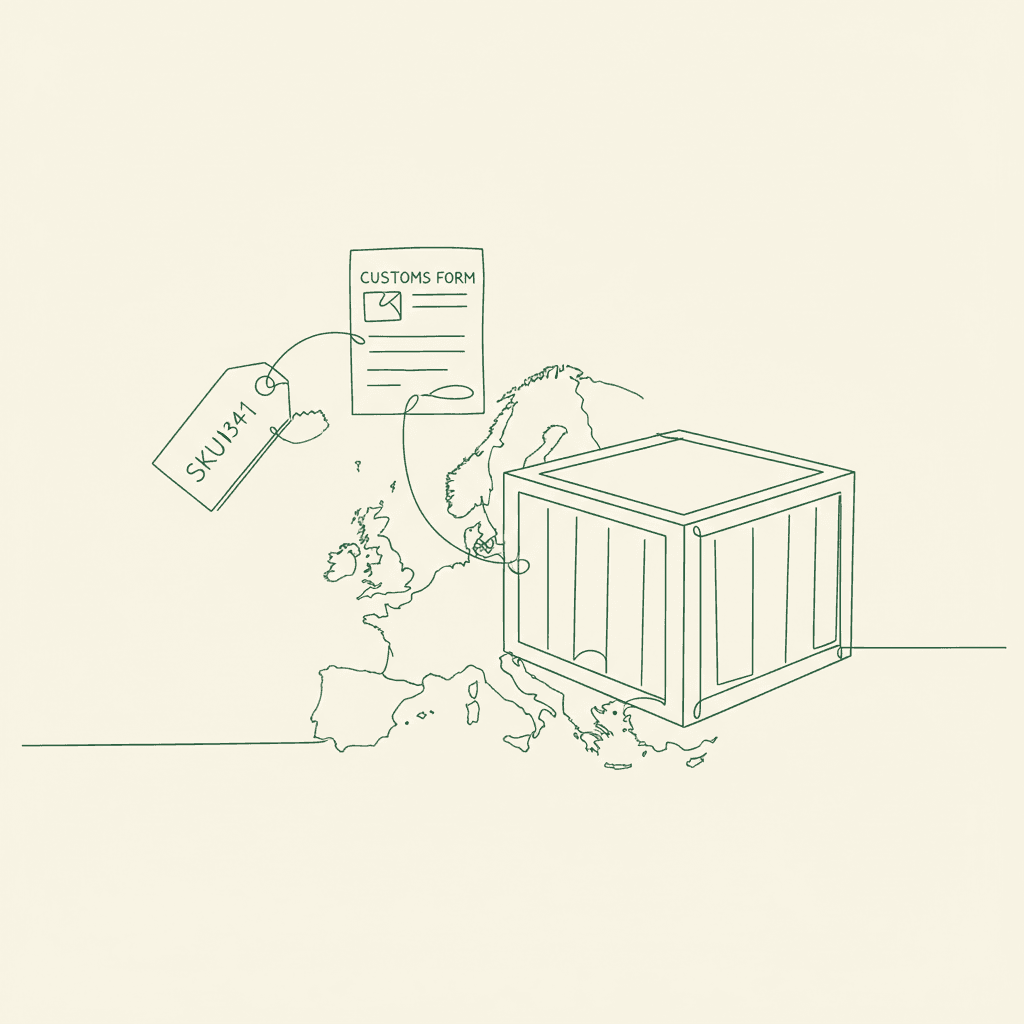
 Nested code blocks stepping from global HS to EU detail
How do HS, CN and TARIC codes differ for B2B brands?
HS, CN and TARIC differ by digit depth and by who publishes the layer you must use on EU paperwork. The Harmonized System (HS) is the international six-digit backbone.[1][2] The Combined Nomenclature (CN) is the EU’s eight-digit extension of HS used for the common external tariff and for much trade reporting.[3][4] TARIC is the EU’s integrated tariff system that presents CN codes plus additional digits and measures (suspensions, anti-dumping, controls, tariff preferences and related footnotes).[5]
For B2B brands the working rule is simple:
- Use HS when you are aligning with non-EU partners at the global heading level or reading supplier sheets written for world trade.
- Use CN when EU statistical or tariff classification at eight digits is required.
- Consult TARIC when you need the measures that sit on top of the nomenclature—whether a product faces extra controls, can claim preferential treatment, or needs a more precise commodity code for declaration.
You do not need every team member to live inside the TARIC browser. You do need one classified code per SKU that matches how you actually ship and invoice, and a clear path to re-check that code when the product or the law changes.
Who owns HS code classification—brand, distributor or freighter?
The brand (or the legal exporter of record on the shipment) should own HS code classification for goods it places on the market, even when a distributor, 3PL or freighter types the declaration. Carriers and customs brokers can advise and file; they rarely have full bill-of-materials context, material percentages, or intended use—the details that separate neighbouring headings in apparel, blended foods, kits or electronics accessories.
A workable split of responsibility looks like this:
- Brand / product or master-data owner: proposes and maintains the commodity code on the SKU, keeps evidence (specs, composition, photos, BTI if any), and signs off changes.
- Commercial / customer ops: ensures the code travels on customer-facing documents and that distributors are not inventing local variants in isolation.
- Warehouse / 3PL / forwarder: uses the code supplied on the commercial invoice and packing list; flags mismatches instead of silently “fixing” them.
- Finance / compliance: ties the same codes into Intrastat or export reporting and retains audit trails.
Distributors sometimes hold their own import classifications in their market. That does not remove the exporter’s duty to describe goods correctly on the documents they issue. If you sell through multiple channels, publish one brand-standard code in wholesale SKU management and treat local deviations as exceptions with a named owner.
When classification is genuinely uncertain, Binding Tariff Information (BTI) is an official written decision from a customs authority on the correct tariff classification of goods.[6] Brands use BTI for ambiguous products, high-duty lines or recurring disputes—not for every SKU. Keep BTI references next to the SKU record so brokers are not working from memory.
 A single product card handing the same label to invoice packing list and customs form
How should you store HS/TARIC codes on wholesale SKUs?
Store HS/TARIC codes as mandatory attributes on SKU master data—the same record that holds units of measure, case packs, net and gross weight, country of origin and preferential origin status where you claim it. Commodity codes belong beside those fields because shipping and invoice lines are built from the SKU, not from a side spreadsheet.
Practical storage rules for wholesale catalogues:
- One authoritative code per sellable SKU (and per distinct case-pack SKU if you sell inner vs master as separate items).
- Separate display description from customs description when marketing names are vague (“gift set”, “assortment”); customs needs composition and function.
- Record the code level you actually use (for example CN8 vs a longer TARIC-based commodity code) and the date it was last reviewed.
- Attach evidence lightly: fibre breakdown, materials list, product URL or spec PDF, and any BTI reference.
- Block order release for new SKUs missing a code when the customer or lane is cross-border—fixing at pick face is how wrong headings spread.
If you run a branded B2B storefront or distributor portal, the code should sit in the product master that prices and fulfils orders so commercial invoices inherit it automatically. Platforms such as Brandgate are built around that master-data-to-document flow for Nordic and EU wholesale teams; the principle holds whether or not you use a dedicated portal: classify once, reuse everywhere.
Avoid maintaining “ops-only” codes in a freight tool that never sync back to ERP or the catalogue. Dual lists drift within a season.
Where do HS codes appear on invoices and shipping documents?
HS codes appear on the commercial invoice and supporting shipping documents so customs officers, brokers and statistical systems can identify the goods without re-interpreting marketing copy. Typical placements in EU B2B wholesale flows:
| Document | Role of the commodity code |
|---|---|
| Commercial invoice | Line-level commodity code with clear goods description, origin, and values |
| Packing list | Same codes aligned to packages, quantities, net/gross weights |
| Customs declaration | Code used for tariff, controls and release; must match supporting docs |
| Bill of lading / CMR | Goods description consistent with invoice; code often carried in EDI or attached docs |
| Intrastat / statistical filing | CN-level codes drawn from the same dispatch data |
The commercial invoice is the spine. If the invoice line shows one heading and the declaration another, expect queries. Packing lists should not invent alternate descriptions for the same SKU. Transport documents (bill of lading or CMR) should stay consistent with the invoice narrative even when the full commodity code lives in the customs file rather than on the face of the CMR.
For multi-line wholesale orders, generate codes from SKU master data at order confirmation or invoice creation. Manual typing at the dock is where digit transposition creeps in. The same discipline supports cleaner cross-border shipping for EU B2B handoffs to forwarders.
 Parcel invoice and waybill linked by one continuous looping line
What breaks when HS codes are wrong or missing?
When HS codes are wrong or missing, friction shows up as delayed release, corrective filings, unexpected duty or preference challenges, and broken trust with distributors who cannot clear goods on time. Common failure modes in wholesale:
- Holds and examinations because the description and code do not match the physical goods.
- Broker rework billed back to the brand while someone hunts for composition data.
- Intrastat or statistical corrections when CN codes on dispatches do not match reality.
- Preference or relief mistakes if a TARIC measure or origin rule was ignored.
- Distributor disputes when landed cost assumptions were built on the wrong heading.
- Catalogue chaos when variants and kits inherit a parent code that no longer fits the bill of materials.
Missing codes are almost as costly as wrong ones: teams stall shipments or guess. Guessing encodes error into history and trains the organisation that classification is optional.
How do HS codes connect to Intrastat and Incoterms without double work?
HS codes connect to Intrastat and Incoterms by feeding one SKU-level classification into documents that already carry dispatch values, partner details and delivery terms—so you do not maintain a parallel customs spreadsheet. Intrastat (and national equivalents) uses 8-digit CN codes and related dispatch data, including statistical value, for intra-EU trade reporting when operators exceed applicable national thresholds; those codes should be the same ones already printed on the invoice lines for the period.[7] Read the mechanics in our guide to Intrastat reporting for B2B wholesale.
Incoterms do not replace commodity codes. Incoterms allocate cost, risk and sometimes responsibility for export or import clearance between seller and buyer. The code still has to be correct on the commercial documents regardless of whether you sell EXW, FCA, CIP or DDP-style arrangements. What changes with the term is who files and who pays duty—not whether the goods need an accurate heading. Keep delivery terms explicit in the contract and on the order, as covered in Incoterms for EU wholesale delivery, and keep commodity codes in the SKU master so whichever party declares is not reclassifying from scratch.
VAT treatment on intra-EU B2B supplies is a separate track from tariff classification, but both depend on clean master data (VAT numbers, ship-to country, invoice content). Align classification work with your wider EU VAT compliance for wholesale process so finance and logistics are not maintaining contradictory customer and product files.
What process keeps classifications accurate as the catalogue changes?
A light, repeatable process keeps classifications accurate as the catalogue changes: classify at introduction, review on trigger events, and retire codes with the SKU—not in a once-a-year panic. Suggested operating rhythm:
- New SKU gate: no cross-border sellable status without commodity code, origin, weights and a plain-language customs description.
- Change triggers: new materials, new mix ratios, kit reconfiguration, rebranded multipacks, shifted manufacturing country, or a broker query.
- Seasonal sample audit: spot-check high-volume and high-risk lines (textiles with fibre rules, food with chapters that hinge on preparation, electronics accessories).
- BTI and dispute log: store outcomes on the SKU; do not leave them in a forwarder’s inbox.
- Owner and backup: name a role (often product ops or supply chain) accountable for the attribute, with finance as reviewer for reporting impact.
- System flow: ERP/PIM/portal share one field; invoice, packing list and customs export pull from it.
Train commercial teams not to promise a duty rate in a quote unless compliance has confirmed the heading and origin story. Sales can still talk lead times and MOQs; classification remains a controlled attribute.
 Catalogue pages with a checklist stamp moving across new product rows
Bringing it back to daily wholesale operations
Accurate commodity codes are part of operational hygiene for EU wholesale—the same family of habits as clean customer VAT numbers, stable SKUs and clear delivery terms. Put HS/CN/TARIC data on the SKU, make the commercial invoice the system of truth for what left the warehouse, and let Intrastat and broker filings reuse that truth.
If your team still pastes codes into shipping forms by hand, start by fixing master data and document templates before adding more tools. When orders, invoices and catalogue live in one branded flow, classification stops being tribal knowledge. See how that sits alongside order-to-invoice automation on a branded B2B storefront, or book a demo if you want to walk through SKU and document setup with Brandgate.