For many EU wholesale brands, the default is a stocked warehouse: import, put away, pick when retailers order. Cross dock wholesale EU flips that model. Goods move from inbound receipt to outbound retailer loads with little or no storage, so capital is not tied up on pallets waiting for the next PO. The catch is simple: if orders, cut-offs and advance shipping notices are messy, cross-dock fails faster than a conventional warehouse.
This guide explains when cross-docking and flow-through beat holding stock, what ASN and order data retailers and 3PLs actually need, and how brands keep fill rate and SLAs intact without treating the B2B portal as a warehouse management system.
What is cross dock wholesale EU and how does it differ from stocked warehousing?
Cross-docking is a logistics model where inbound goods are received, sorted and shipped outbound with little or no put-away into long-term storage.[1] In wholesale terms, a container or trailer arrives, lines are matched to open retailer orders, and cartons or pallets are staged for the next outbound run—often the same day or within a short operational window.
A stocked warehouse does the opposite: you receive, put away, and pick later against whatever orders arrive. You absorb demand spikes and at-once reorders from inventory, but you carry stock, handling and the risk of slow movers.
Flow-through fulfillment sits between the two. Goods may be briefly held or sorted in a staging area while allocations are confirmed, labels applied and loads built, but the intent is still rapid outbound rather than replenishing a pick face. Many seasonal wholesale programmes run as flow-through even when teams loosely call the whole setup “cross-dock”.
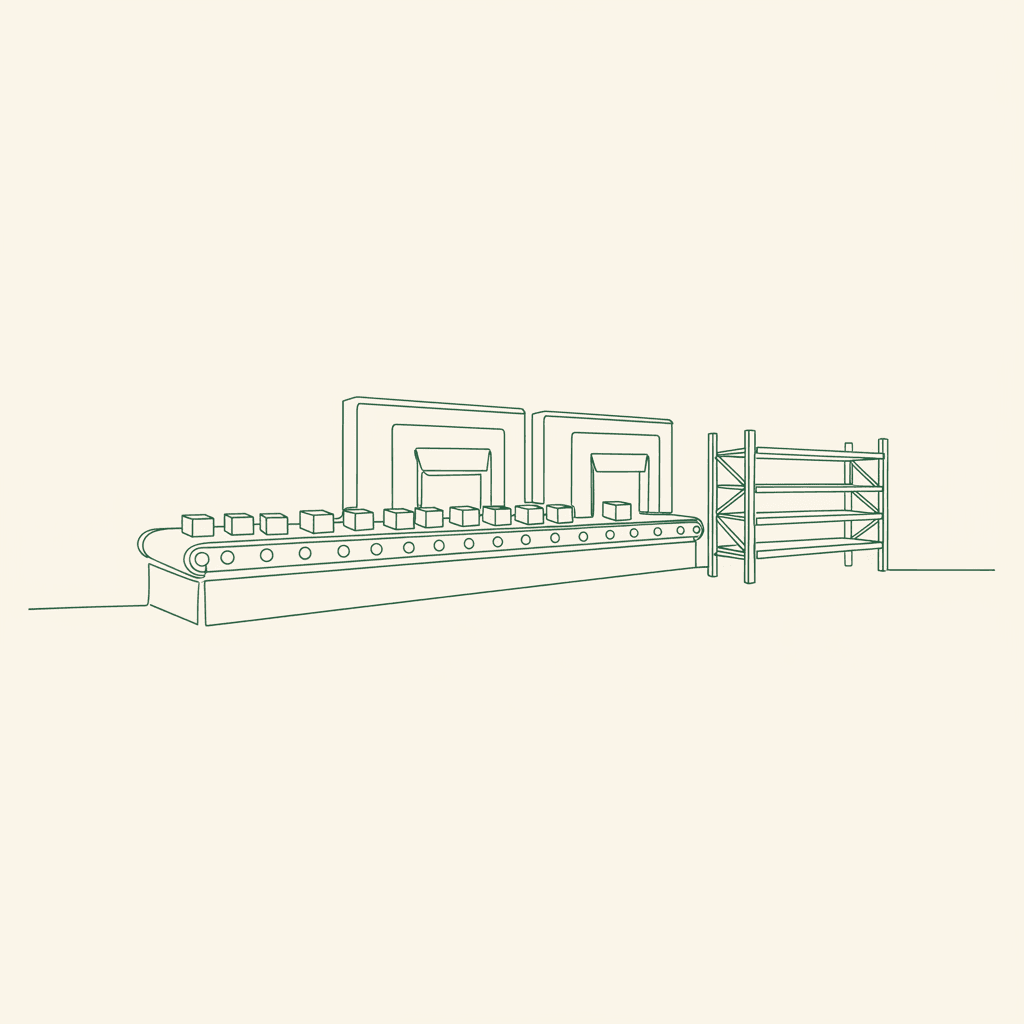
 Inbound pallets moving straight across a dock to outbound retailer loads
When does cross-dock beat a stocked warehouse for import-heavy brands?
Cross-dock tends to beat stock when three conditions line up: demand is known early, inbound is batchy, and retailers can accept a planned delivery window.
Import-heavy EU wholesale is a natural fit. Ocean or long-haul inbound arrives in waves. If prebook orders already cover most of the container, holding everything in a Nordic or central EU warehouse only adds rent, double handling and working capital. Landed cost stays cleaner when you avoid extra storage and re-picks—though you still need a clear view of duty, freight and handling when you set wholesale prices.
Cross-dock also fits when assortment is drop- or season-driven rather than continuous replenishment: fashion drops, outdoor seasons, gift periods, limited food or beauty launches. You sell against a production or import plan, lock retailer orders before goods move, and allocate on the dock.
It is a weak fit when retailers live on short at-once cycles, when every account needs different ship-from speed, or when SKU and case-pack complexity makes dock-side allocation error-prone. Then a stocked node—or a hybrid—usually protects service better.
Prebook versus at-once matters here. Prebook gives you the order book that cross-dock needs; pure at-once assumes stock or a very fast replenishment path. Brands that mix both often cross-dock the seasonal buy and keep a thinner local buffer for top-up lines. For how those order types differ commercially, see wholesale prebook vs at-once.
How does flow-through fulfillment work for seasonal wholesale?
Flow-through fulfillment for seasonal wholesale starts with a locked order book and a known inbound ETA. Retailers place prebook orders against a catalogue with clear case packs and GTINs. The brand or 3PL builds a wave plan: which inbound shipment feeds which outbound departures, by retailer, destination and carrier product.
When goods clear customs and hit the dock, teams scan and sort to retailer or route rather than to a bulk location. Short staging is allowed for quality checks, labelling, and building mixed pallets. Outbound leaves on agreed cut-offs. Leftover units—if any—are the exception, not the plan; they may go to a small residual stock location, a secondary channel, or a planned follow-up wave.
Operationally, the calendar is the product: order cut-off, inbound cut-off, ASN deadline to the retailer, and dispatch SLA must be published and shared with sales so nobody promises stock that only exists as a vessel position.
 Seasonal goods flowing through a hub toward multiple retailer destinations
What order and ASN data do retailers and 3PLs need for cross-dock?
An advance shipping notice (ASN) is a structured message that tells the receiver what is coming, in what packs, before the truck arrives. Under GS1 EDI practice, that electronic form is commonly a DESADV (despatch advice) message.[2] Cross-dock without a usable ASN pushes cost and delay onto the retailer’s DC: blind receiving, manual checks and refused loads.
At minimum, brands and their 3PLs should be ready to supply:
- Retailer PO reference and your order/shipment IDs
- Line-level SKU identity with GTIN (unit and case where both are traded)
- Quantities by pack hierarchy: units, inner packs, cases, pallets
- SSCC or equivalent licence-plate IDs on logistics units when the retailer requires scan-based receipt
- Delivery location, booked slot or agreed window, and carrier details
- Batch, lot or best-before data when the category needs it
- Catch-weight or variable measures only if the account truly trades that way
Order data upstream of the ASN must be equally clean. Case-pack errors, missing GTINs and free-text “notes instead of lines” force dock-side improvisation. A branded B2B ordering process that forces structured lines, pack sizes and cut-off-aware confirmation does more for cross-dock reliability than another forklift. Catalogue setup for units and cases is covered in our GTIN wholesale catalogue guide.
 Advance shipping notice connected to labelled cartons on a dock
Which Incoterms and ship-from setups fit cross-dock in the EU?
Incoterms® rules clarify who pays for transport, who bears the risk of loss or damage during carriage, and who handles related customs formalities between seller and buyer.[3] They do not by themselves create a cross-dock, but the wrong term fights the model. If you sell under terms that make the retailer responsible for import and long-haul, your “cross-dock” may be little more than a handover point you do not control. If you sell delivered into the retailer’s DC or a nominated 3PL, you own the plan that makes dock-to-dock timing work.
Common patterns for EU import wholesale:
- Brand imports into free circulation, cross-docks in an EU hub, delivers to retailers under a delivered-style domestic or intra-EU arrangement
- Brand uses a 3PL hub near the port or border; ship-from is that hub, not a distant stocked warehouse
- Split networks: cross-dock for seasonal inbound, stocked regional nodes for at-once—each with explicit ship-from rules so the order promise matches reality
Bonded versus free-circulation stock changes what you can allocate and when. Goods not yet released may be physically near the dock but unavailable for domestic retailer dispatch until customs processes complete. Plan waves on clearance status, not only on vessel arrival.
For term definitions and practical wholesale use, see Incoterms for EU wholesale delivery. For how multiple nodes should appear in the order path, see EU multi-warehouse ship-from rules.
How do you keep fill rate and SLAs intact without holding stock?
Fill rate is the share of ordered lines or units you actually ship as promised. Without on-hand stock, fill rate is really plan quality: did you sell only what inbound can cover, freeze changes before the wave, and stop late order edits from punching holes in loads?
Practical controls:
- Publish order cut-offs per wave and enforce them in the ordering channel—not only in an email to sales
- Confirm substitutions and partials before inbound sort, not on the dock under time pressure
- Measure short-ships by cause: late PO change, supplier shortfall, scan/pack error, carrier leave-behind
- Keep a small, deliberate residual policy so unexpected shortages do not silently become random allocations
- Align the wholesale order SLA from cut-off to dispatch with what the 3PL can physically turn
SLAs should name the milestones that cross-dock cares about: order freeze, ASN send time, dispatch scan, and carrier handover—not a vague “ships in x days” copied from a stocked model. A clear wholesale order SLA from cut-off to dispatch stops retail and ops arguing from different clocks.
What systems should sync: WMS, carriers, and the B2B portal?
Cross-dock is unforgiving when systems disagree. The B2B portal (or order desk) owns the commercial order: customer, lines, packs, promised wave and ship-from. The WMS owns inventory state at the hub: receipt, sort locations, packing, SSCC, dispatch. Carriers own label, booking and tracking events after handover.
What should move between them is boring and essential: confirmed order lines and pack hierarchy into the WMS; receipt and shortage events back to the order layer; ASN content to retailer channels; label and tracking references back to the order for status. Brands should not pretend the portal is a WMS—but they should insist the portal does not lie about what can still be ordered into a wave.
Prioritise the master data that breaks docks: GTIN and case pack, ship-to validity, cut-off calendars, and carrier service codes per lane. For a deeper checklist of warehouse-facing fields, use WMS data brands should sync for wholesale. For outbound execution, pair that with carrier labels and tracking for B2B wholesale.
Brandgate sits on the commercial side of this picture: a branded distributor portal, structured wholesale orders and order-to-invoice flow so cut-offs, confirmed lines and retailer-ready order data exist before the 3PL builds the wave—not a replacement for WMS or yard management.
 Order, warehouse and carrier systems linked as one continuous path
When should EU brands stick with multi-warehouse stock instead?
Stay stocked—or hybrid—when service design needs inventory buffers. Typical cases:
- Dense at-once reordering from many small retailers who will not prebook full seasons
- Category rules that need FEFO, remaining shelf life or lot control best handled from held stock
- High return or quality-variance lines that must be inspected offline before release
- Local same-week SLAs across distant markets that a single port cross-dock cannot cover
- Assortments with awkward pick units where dock-side allocation is slower than a designed pick face
Many Nordic and wider EU brands run both: cross-dock or flow-through for the import season wave, and multi-warehouse stock for replenishment and key accounts. The failure mode is not choosing stock—it is letting the order channel promise cross-dock timing on lines that only exist in a distant buffer, or the reverse.
Practical checklist before you switch a line to cross-dock
- Map the order book: share of prebook versus at-once for that range.
- Freeze pack hierarchy and GTINs; stop selling units you cannot label as cases on the dock.
- Agree ASN/DESADV content and timing with priority retailers and the 3PL.
- Publish cut-offs and ship-from rules in the same place retailers order.
- Define residual and short-ship rules before the first container lands.
- Rehearse one wave end-to-end—including carrier booking and tracking back to the order—before peak season.
Cross-dock wholesale in the EU rewards brands that treat the dock as the last step of a clean order process, not the first place where data is fixed. If your team still rebuilds orders from spreadsheets while goods are on the water, fix visibility first; the warehouse model will not save you.
When you want retailers to place structured wholesale orders against clear cut-offs and catalogues—with a branded portal and orderly handoff toward dispatch and invoice—book a demo or see pricing.