What is sustainability data in B2B wholesale?
Sustainability data in B2B wholesale is the set of product- and supply-chain attributes retailers and distributors request so they can assess environmental impact, meet buyer policies and feed their own ESG reporting. It sits in the B2B wholesale catalogue and SKU master data alongside price, GTIN, pack size and stock—not in a separate sustainability inbox.
In practice it covers three layers: measurable product attributes (for example product carbon footprint and packaging composition), evidence files (certificates of conformity, due-diligence statements, test reports), and regime-specific compliance payloads (chemical, deforestation, packaging and similar rules). Many EU retail groups ask for this next to the line item because in-scope companies under frameworks such as the Corporate Sustainability Reporting Directive (CSRD) and the Corporate Sustainability Due Diligence Directive (CSDDD) need material value-chain and due-diligence information, which often means collecting supplier and product inputs upstream.[1][2]
 Open catalogue page with a leaf icon linked to a product card
Which carbon and emissions fields do EU retailers request?
EU retailers most often ask for a product carbon footprint (PCF)—or a clear statement that one is not yet available—plus the method and boundary used. A product carbon footprint is an estimate of greenhouse gas emissions attributable to a defined unit of product across a stated life-cycle scope.[3]
Useful catalogue fields include:
- PCF value and unit (for example per selling unit or per kg)
- Life-cycle boundary (cradle-to-gate vs cradle-to-grave)
- Calculation method or standard reference (for example GHG Protocol Product Standard or PEF-oriented approaches)[3][4]
- Data quality or vintage note (year of study, primary vs secondary data)
- Whether the figure is third-party verified
Scope 3 emissions are the indirect value-chain emissions in a company’s inventory (excluding Scope 2).[5] Retailers reporting Scope 3 purchased-goods figures often need SKU- or category-level factors from brands; a catalogue field that points to a consistent PCF or category factor reduces spreadsheet chases. Keep the claim modest: publish what you can defend, mark gaps explicitly, and avoid mixing incompatible methods on the same line sheet without a note.
How should packaging and recyclability data sit in the catalogue?
Packaging sustainability fields belong on the pack hierarchy (unit, inner, case, pallet), not only on the marketing SKU. EU packaging policy—including the Packaging and Packaging Waste Regulation (PPWR)—requires packaging placed on the market to be recyclable, sets recycled-content targets for specified plastic packaging, and provides for harmonised material-composition labelling to support sorting.[6] Retailers use the same data for shelf-ready specs, waste-contractor rules and own-brand scorecards.
Structure fields such as:
- Primary / secondary / tertiary material types and weights
- Packaging recyclability status (and the scheme or criteria used)
- Recycled content share by material, where known
- Reuse or deposit flags (link out to your rules for returnable packaging and EU deposit rules)
- Labelling or marking notes relevant to the selling market
Hold free-text “sustainable pack” slogans out of filterable attributes. Buyers need comparable fields; marketing copy can sit in a rich-text block below.
 Nested packaging layers from unit to case with simple material symbols
What due-diligence and ESG documents belong next to SKUs?
Due-diligence and ESG documents are the evidence layer. Typical attachments or linked assets include:
- Due-diligence statements or summaries tied to a product group or origin
- Certificates of conformity and declarations of compliance
- Material or substance declarations
- Audit or certification PDFs (with expiry dates as metadata)
- Regime packs such as deforestation due-diligence information where EUDR data brands must share with buyers applies
- Chemical compliance files aligned with REACH compliance in the wholesale catalogue
Store document type, language, validity window and applicable markets as metadata. That lets a French buyer pull the FR pack and a Swedish buyer the SE pack without emailing sales. Pattern this the same way you already handle structured product facts for food—see allergen and product data patterns for F&B—so sustainability is not a one-off exception in the PIM or catalogue model.
How does sustainability data relate to REACH, EUDR and other compliance files?
Sustainability attributes and legal compliance files overlap but are not identical. REACH-oriented substance data, EUDR operator/trader information for relevant commodities and products, packaging declarations and carbon figures answer different questions.[7] The operational rule is simple: one SKU record, multiple controlled document slots and attribute groups, shared identifiers (GTIN, internal SKU, batch or shipment hooks where needed).
Map each file to:
- Legal regime or voluntary standard
- Product scope (SKU, variant, material, or supplier lot)
- Who may download it (all approved retailers vs role-restricted)
That separation stops a generic “ESG zip” from burying the one certificate a customs or quality team actually needs, while still letting CSRD-driven retail buyers collect supplier inputs in a predictable shape.
How do you structure sustainability fields for search and filters?
Structure for catalogue search filters retailers actually use: discrete enums and numeric ranges beat paragraphs. Examples that work in a distributor portal:
| Field group | Example filterable attributes |
|---|---|
| Carbon | PCF available (yes/no), boundary, verified (yes/no) |
| Packaging | Main material, recyclability class, recycled-content band |
| Materials | Certified fibre/content flag, key substance restriction status |
| Documents | Has valid certificate of conformity; EUDR pack present |
| Origin / diligence | Country/region of primary material; due-diligence statement on file |
Use the same patterns as commercial filters—clear labels, stable codes, no synonym sprawl. Guidance on how retailers actually filter ranges sits in our note on catalogue search filters retailers actually use. Publish a short data dictionary so sales, quality and external marketplaces do not invent parallel field names.
 Filter chips beside product tiles on a calm B2B catalogue screen metaphor
What is worth standardising for cross-border EU buyers?
Cross-border EU buyers punish inconsistency more than missing optional fields. Standardise:
- Field names and allowed values in a single master list (localise labels, not codes)
- Units for mass, volume and carbon
- Document taxonomy (type codes, not free filenames)
- Language strategy for certificates (original plus agreed translations)
- What “unknown / not assessed” means so empty never looks like zero impact
CSRD- and CSDDD-oriented retail questionnaires still vary by group, but a stable core of PCF, packaging, material and due-diligence evidence covers most first-pass requests. Industry-specific extras (textile fibre composition, food contact, electronics substance lists) extend the same model rather than replacing it.
Where should brands host certificates without slowing ordering?
Host certificates in the same SKU master data plane as commercial attributes, behind the authenticated distributor portal or branded B2B storefront. Buyers should open a product, see sustainability fields, download current files and add to cart without leaving the ordering path. Version documents, show expiry, and restrict sensitive packs by role when needed—ordering users should not wade through internal audit workpapers.
Avoid mailing PDFs per PO or parking everything only on a corporate sustainability website. Those patterns break re-ordering and multi-buyer retailer teams. A practical setup keeps product data, sustainability attributes and compliance documents together so Nordic and wider EU wholesale customers self-serve; Brandgate is one portal layer built for that catalogue-plus-document pattern beside everyday order-to-invoice flow.
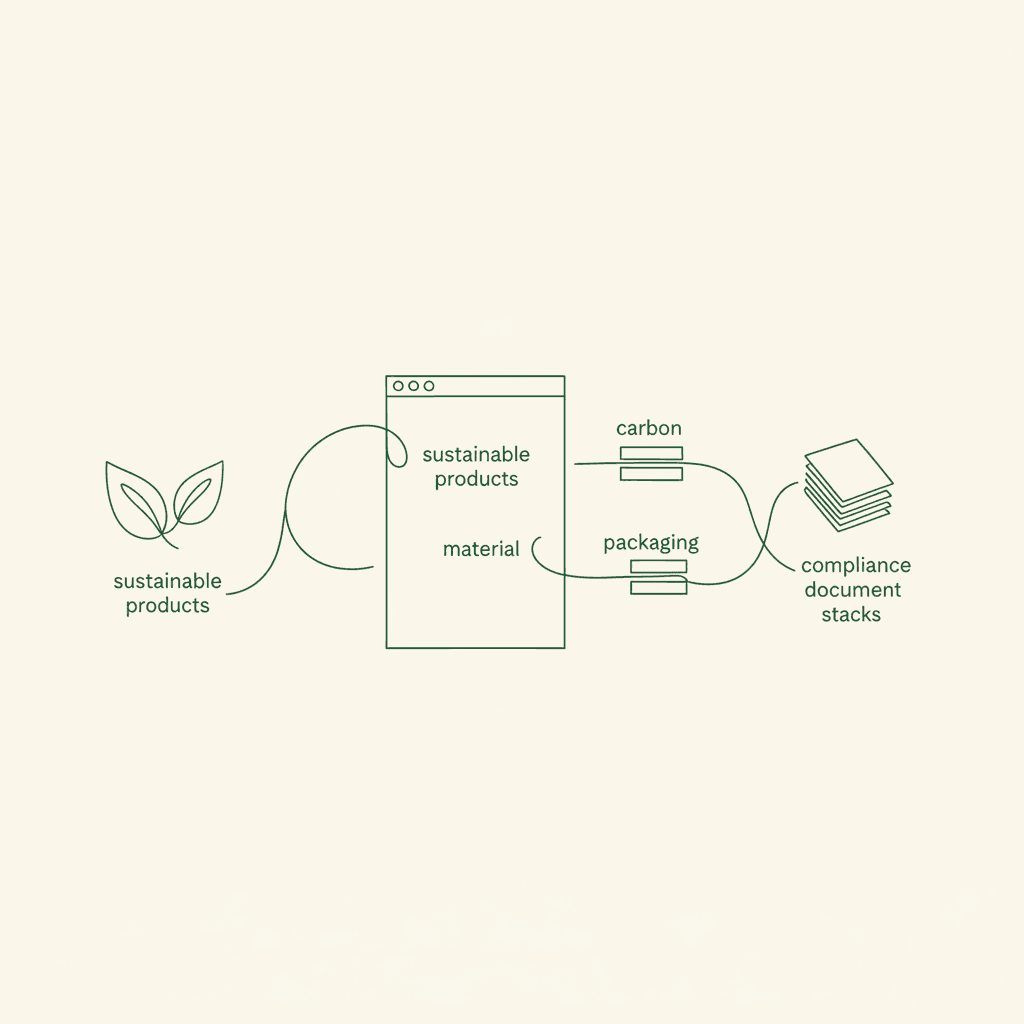
 Single portal doorway with product, leaf and document flowing through one path
Practical rollout order
- Inventory what retailers already request in onboarding packs and tender sheets.
- Define the minimum viable attribute set (carbon, packaging, key material flags) and document types.
- Attach owners: who updates PCF, who renews certificates, who approves public wording.
- Load SKU master data; mark gaps honestly.
- Expose fields and downloads in the catalogue; wire filters only on clean enums.
- Train sales to point buyers at the portal instead of forwarding attachments.
Keep improvement iterative. A complete life-cycle model on every SKU is less valuable than consistent, dated, comparable fields on the products you actually sell into regulated EU retail.
When you want sustainability and compliance data sitting beside price and stock in a branded ordering experience, book a demo or see pricing.