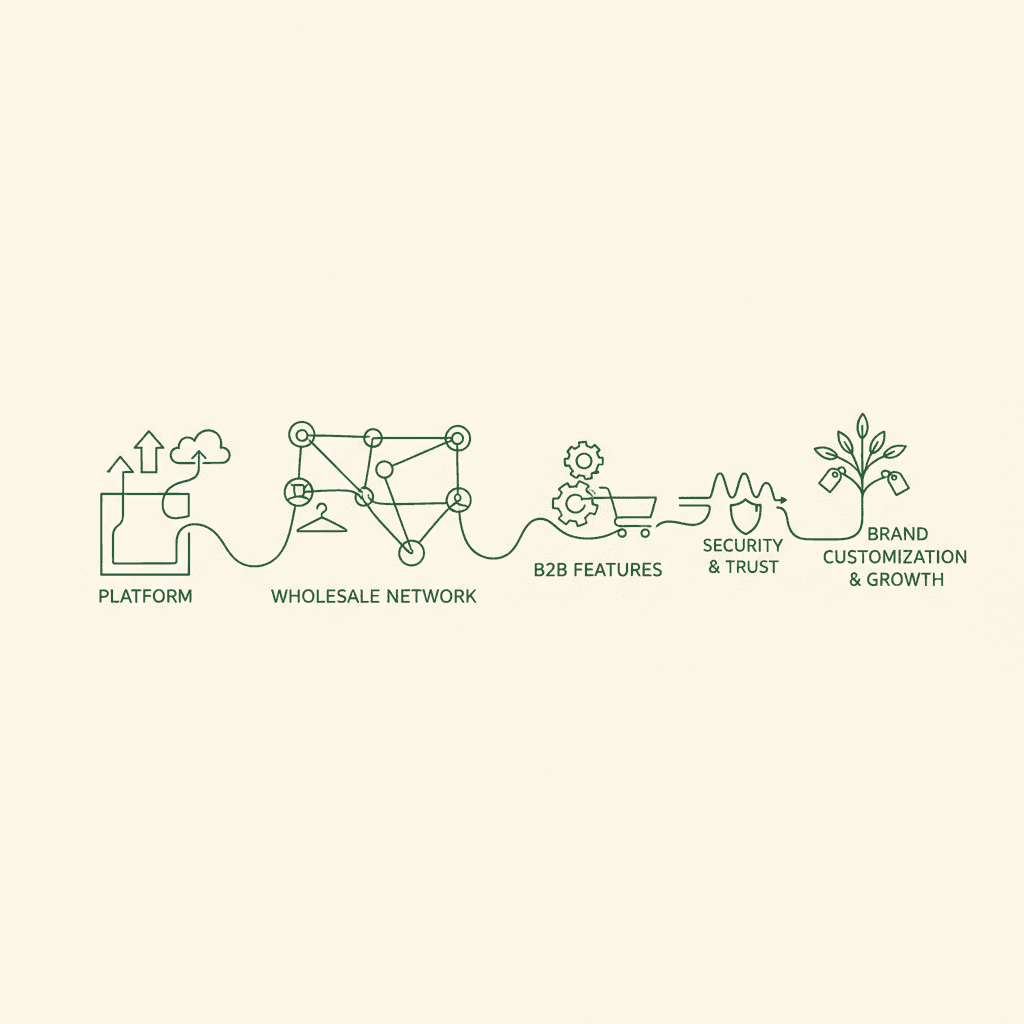
Running wholesale on spreadsheets, email threads, and manual invoicing works until it doesn't. As your distributor network grows and you expand across borders, the cracks appear: orders get lost, pricing errors multiply, VAT compliance becomes a headache, and your finance team drowns in re-keying.
A purpose-built B2B wholesale platform consolidates these fragmented workflows into a single system. But not all platforms are created equal. The right B2B wholesale platform features can transform your wholesale operation from a manual slog into a scalable, efficient engine for growth.
This guide walks through the essential capabilities every wholesale brand should evaluate—from branded distributor portals and order management to multi-currency support, compliance tooling, and ERP integration.
What are the core B2B wholesale platform features?
The core B2B wholesale platform features are a branded distributor portal for self-service ordering, comprehensive order management from placement through invoicing, multi-currency catalogue support, VAT-aware invoicing, and native integration with your accounting system. These capabilities form the foundation that replaces email-and-spreadsheet workflows with automated, auditable processes.
A distributor portal gives your retailers and distributors a branded, self-service storefront where they log in, browse your catalogue, check stock availability, and place orders directly. This eliminates the back-and-forth of email orders and reduces errors from manual transcription.
Order management tracks each order from initial placement through picking, packing, shipping, and invoicing. Visibility across the entire lifecycle means you know what's in progress, what's been fulfilled, and what's outstanding at any moment.
Multi-currency catalogues let you price in SEK, EUR, NOK, DKK, or other currencies without maintaining separate spreadsheets. VAT-aware invoicing calculates the correct tax treatment—domestic VAT, reverse charge, or zero-rated—based on buyer location and status.
Native ERP integration, particularly with platforms like Fortnox in the Nordics, syncs orders, invoices, payments, and customer records automatically. This eliminates double entry and keeps your books accurate without manual reconciliation.
 A branded storefront interface with product catalogue and shopping cart
Why are specific B2B wholesale platform features crucial for wholesale brands?
Wholesale brands face operational challenges that consumer e-commerce platforms aren't designed to solve. You're managing complex pricing structures—tiered discounts, volume breaks, distributor-specific rates—not one-size-fits-all retail pricing. You're invoicing businesses with credit terms, not processing instant card payments. You're navigating cross-border VAT rules, not charging a single sales tax.
Without the right platform features, these complexities force manual workarounds. Pricing lives in spreadsheets that get out of sync. Orders arrive by email and someone re-keys them into Fortnox by hand. VAT calculations happen in separate tools or on paper. Distributor onboarding means sending PDF catalogues and setting up accounts manually.
Each manual step introduces delay and error. A mistyped SKU ships the wrong product. A stale price list costs you margin. A VAT mistake triggers a compliance issue. These aren't edge cases—they're the daily reality of running wholesale without purpose-built tooling.
The right B2B wholesale platform features automate these error-prone tasks, enforce consistency, and give you a single source of truth. When a distributor places an order through your portal, the system applies the correct pricing tier, calculates VAT based on their location, generates the invoice, and syncs it to Fortnox—all without human intervention. That's the difference between scaling smoothly and hitting an operational ceiling.
How do B2B platforms improve order management and inventory control?
Order management in a B2B wholesale platform centralizes every order in one system, tracks its status in real time, and provides visibility to both your team and your distributors. Instead of hunting through email threads or spreadsheets to find out whether an order shipped, everyone sees the current state: pending, confirmed, picked, shipped, invoiced.
This visibility extends to inventory. When distributors log into your portal, they see real-time stock levels for each SKU. If a product is out of stock or running low, they know immediately—before placing an order that can't be fulfilled. This reduces frustration, cuts down on support queries, and helps distributors plan their own inventory.
On your side, centralized order data makes it easier to spot patterns: which products are moving fastest, which distributors are reordering regularly, which regions are growing. You can forecast demand more accurately and make smarter purchasing decisions.
Integration with your warehouse or fulfillment system closes the loop. When an order is picked and packed, the platform updates the status automatically. When stock arrives, inventory levels refresh. This real-time sync keeps everyone—sales, operations, finance—working from the same information.
For brands upgrading from spreadsheets, the shift to automated order and inventory management is transformative. What used to require constant manual updates and cross-checking happens automatically, freeing your team to focus on growth rather than administration.
 A dashboard showing order pipeline and inventory levels across warehouses
What financial and compliance features are essential for a wholesale platform?
Financial and compliance features separate a true B2B wholesale platform from a repurposed consumer e-commerce tool. At the core: multi-currency pricing, VAT-aware invoicing, and native accounting integration.
Multi-currency catalogues let you maintain separate price lists in different currencies—SEK for Swedish distributors, EUR for the rest of the EU, NOK for Norway. The platform handles currency conversion, applies the correct prices automatically, and invoices in the buyer's currency. This avoids the confusion and errors of manual currency calculations.
VAT-aware invoicing is non-negotiable for brands operating across EU borders. The platform must determine the correct VAT treatment based on buyer location, VAT registration status, and product type. Domestic sales within Sweden charge Swedish VAT. Sales to VAT-registered businesses in other EU countries apply the reverse charge mechanism (zero-rated, with the buyer self-assessing VAT).[1] Sales to non-EU countries are zero-rated for export.[2]
Getting VAT wrong is costly—underpayment triggers penalties, overpayment eats margin, and incorrect invoices create compliance headaches for your buyers. A platform that calculates VAT automatically, applies the right rules, and documents the logic on each invoice removes this risk.
Native integration with your accounting system—Fortnox, Visma, or another ERP—syncs invoices, payments, and customer records in real time. When an order is invoiced in the platform, the invoice appears in Fortnox immediately, with line items, VAT, currency, and customer details intact. When a payment is recorded in Fortnox, the platform updates the order status. This two-way sync eliminates manual re-keying and keeps your financial records accurate.
For brands selling internationally, these features aren't nice-to-haves—they're the foundation of compliant, scalable operations.
How can a B2B platform enhance the retailer and distributor experience?
Your distributors and retailers are your customers. A clunky, manual ordering process frustrates them, slows down reorders, and makes your brand harder to work with than competitors who've invested in better tooling.
A branded distributor portal flips this dynamic. Distributors log into a storefront that looks and feels like your brand—your logo, your imagery, your tone. They browse a curated catalogue with product photos, descriptions, and specs. They see real-time pricing (including their specific tier or discount) and stock availability. They place orders with a few clicks, review order history, download invoices, and track shipments—all self-service, 24/7.
This self-service model reduces friction. Distributors don't wait for your sales team to respond to an email or send a quote. They don't wonder whether a product is in stock or what their price is. The information is right there, and they can act on it immediately.
Streamlined retailer onboarding is another key feature. Instead of emailing PDFs back and forth and manually setting up accounts, the platform lets new retailers apply online, submit documentation (business registration, VAT number), and get approved through a structured workflow. Once approved, they have instant access to the portal and can start ordering.
Clear communication features—order confirmations, shipping notifications, invoice delivery—keep distributors informed without requiring your team to send manual updates. Transparency builds trust and reduces support load.
For distributors managing their own retail channels, speed and reliability matter. A platform that makes ordering easy, accurate, and fast strengthens the relationship and encourages repeat business.
 A retailer browsing a branded product catalogue on a tablet
What integration capabilities should you look for in a B2B wholesale platform?
Integration capabilities determine whether your B2B wholesale platform becomes the central hub of your operations or just another siloed tool. The most critical integration is with your accounting and ERP system—especially Fortnox for Nordic brands.
A native Fortnox integration syncs customers, products, orders, invoices, and payments bidirectionally. When you add a product in Fortnox, it appears in your wholesale catalogue. When a distributor places an order, the platform creates the invoice in Fortnox automatically, with correct VAT, currency, and payment terms. When a payment is recorded, both systems update. This eliminates double entry, reduces errors, and keeps your financial data consistent.
Beyond accounting, look for integrations with:
- Warehouse and fulfillment systems: Sync inventory levels, push orders to your warehouse for picking, and pull tracking numbers back into the platform.
- Shipping and logistics providers: Generate shipping labels, calculate freight costs, and provide tracking to distributors automatically.
- CRM and customer data platforms: Keep distributor contact details, order history, and communication in sync across systems.
- Payment processors: For brands that accept card payments or offer financing, integration with Stripe, Klarna, or other processors streamlines payment collection.
The best platforms offer both pre-built integrations for common tools and flexible APIs for custom connections. Pre-built integrations get you up and running quickly; APIs let you tailor the system to your specific workflows.
For brands evaluating platform integrations, prioritize the systems you already use daily. A platform that integrates seamlessly with Fortnox, your warehouse software, and your shipping provider will deliver immediate value. A platform that requires you to change your entire tech stack creates friction and delays.
How do you choose the right B2B wholesale platform for your business?
Choosing the right B2B wholesale platform starts with understanding your specific pain points and growth plans. Map out your current workflow: where do orders come from, how do they get into your system, who handles pricing and invoicing, how do you manage VAT, and where do errors or delays occur most often?
Then evaluate platforms against the essential features:
- Branded distributor portal: Can distributors self-serve? Is the portal customizable to your brand? Does it show real-time pricing and stock?
- Order management: Does it track orders end-to-end? Can you see status at a glance? Does it handle partial shipments and backorders?
- Multi-currency and VAT: Does it support the currencies and markets you operate in? Does it calculate VAT correctly for EU cross-border sales?
- Accounting integration: Does it integrate natively with Fortnox (or your ERP)? Is the sync real-time and bidirectional?
- Retailer onboarding: Does it streamline approvals and account setup? Can new distributors start ordering quickly?
- Reporting and analytics: Can you see which products, distributors, and regions are performing? Can you export data for deeper analysis?
Ask vendors for demos focused on your specific use case. Don't settle for generic walkthroughs—show them your catalogue, your pricing structure, your distributor types, and your VAT scenarios. See how the platform handles your complexity.
Check references from brands in your industry and region. A platform that works well for fashion brands in Sweden may not suit food & beverage distributors in Germany. Look for proven success with businesses similar to yours.
Consider total cost of ownership: subscription fees, implementation costs, training time, and ongoing support. A cheaper platform that requires constant manual workarounds or expensive custom development isn't actually cheaper.
Finally, think about growth. Will the platform scale as you add distributors, enter new markets, or expand your catalogue? Can it handle increased order volume without performance issues? Choosing a platform you'll outgrow in a year creates churn and disruption.
For Nordic wholesale brands, platforms like Brandgate are purpose-built for this exact challenge: branded distributor portals, Fortnox-native integration, multi-currency catalogues, VAT-aware invoicing, and full order-to-invoice automation. Exploring Brandgate features alongside other options gives you a clear sense of what best-in-class B2B wholesale platform features look like in practice.
Making the move to a modern B2B wholesale platform
The right B2B wholesale platform features transform wholesale from a manual, error-prone grind into a streamlined, scalable operation. A branded distributor portal gives your retailers a professional, self-service ordering experience. Automated order management and inventory visibility eliminate guesswork and reduce support load. Multi-currency catalogues and VAT-aware invoicing make cross-border sales compliant and efficient. Native Fortnox integration keeps your books accurate without double entry.
These aren't luxury features—they're the baseline for competitive wholesale operations in the Nordics and wider EU. Brands still running on spreadsheets and email are losing time, margin, and distributor goodwill to competitors who've invested in better tooling.
If your current setup is holding you back, it's time to evaluate purpose-built platforms. Book a demo to see how Brandgate's B2B wholesale platform features can streamline your operations, or explore pricing to understand the investment.