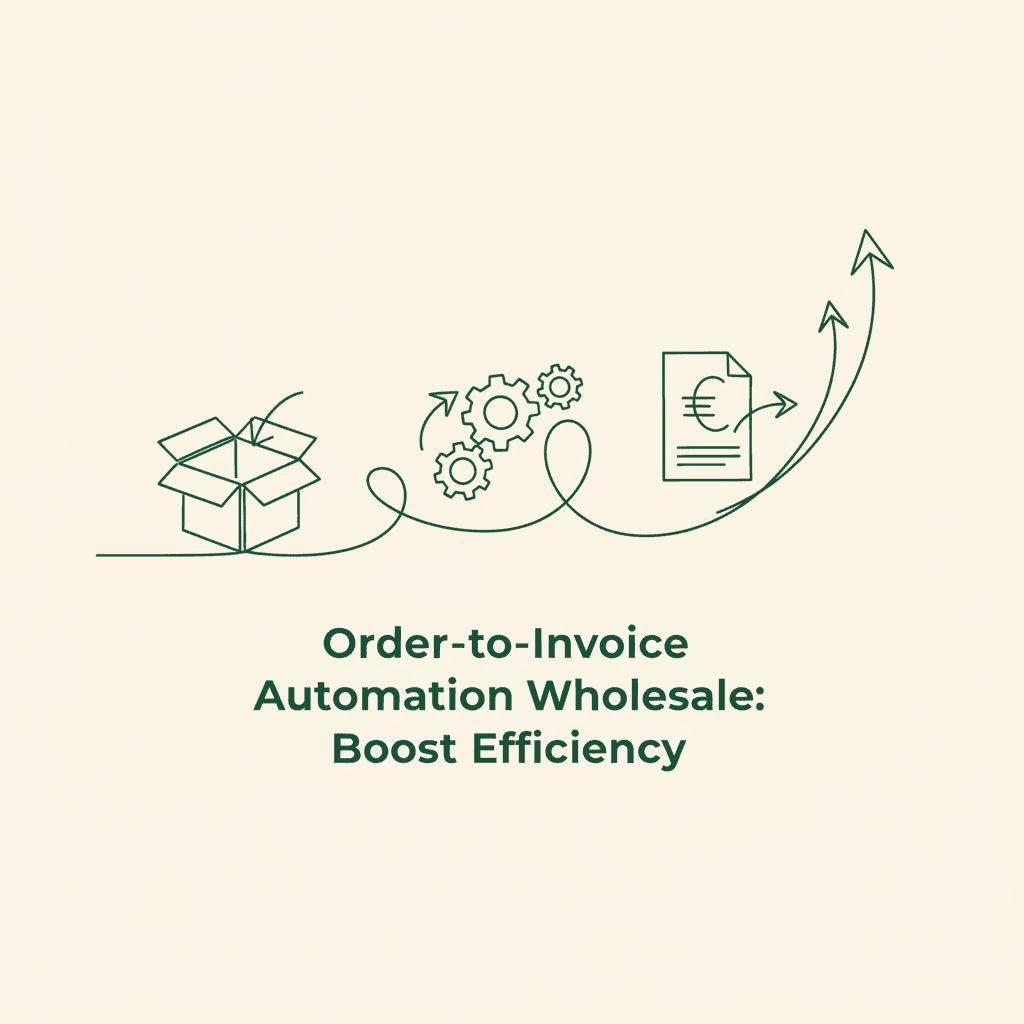
Running wholesale on spreadsheets, email, and manual invoicing creates bottlenecks that slow your business down. Every purchase order that arrives by email needs to be manually re-entered into your accounting system, every invoice typed out line by line, and every payment chased and reconciled by hand. Order-to-invoice automation wholesale eliminates these friction points, connecting the entire workflow from the moment a distributor places an order to the moment you receive payment.
For wholesale brands and distributors across the Nordics and EU, automation is not about replacing people—it is about removing the repetitive, error-prone tasks that drain time and create costly mistakes. When your order-to-invoice cycle runs on autopilot, your team can focus on building relationships, expanding your distributor network, and growing revenue.
 A continuous loop connecting a package, document, and payment symbol
What is order-to-invoice automation in wholesale?
Order-to-invoice automation in wholesale is the end-to-end digitisation of the process that starts when a distributor or retailer places a purchase order and ends when you receive payment and reconcile it in your accounts. Instead of manually handling each step—transcribing orders, creating invoices, sending reminders, updating inventory, and matching payments—automation connects these stages through integrated software.
The typical order-to-invoice cycle includes several distinct stages. A distributor submits a purchase order, which becomes a sales order in your system. That sales order triggers inventory allocation, generates a VAT-compliant invoice in the correct currency, and sends it to the buyer. Payment is tracked, and once received, the transaction is automatically reconciled in your ERP or accounting platform. Each of these steps can be automated, removing the need for manual data entry and reducing the risk of errors at every handoff.
For brands selling B2B across borders—especially in the EU where VAT rules and multi-currency pricing add complexity—automation ensures compliance and accuracy without requiring your finance team to become tax experts.
What are the common challenges of manual wholesale order processing?
Manual wholesale order processing is slow, error-prone, and difficult to scale. When distributors send orders by email or phone, someone on your team must re-key every line item into your accounting system. This transcription step introduces mistakes—wrong SKUs, incorrect quantities, mistyped prices—that cascade into invoicing errors, shipment delays, and customer disputes.
Reconciliation becomes a monthly headache. Matching payments to invoices by hand is tedious, especially when dealing with multiple currencies, partial payments, or distributors who reference the wrong invoice number. Your finance team spends hours cross-checking spreadsheets instead of analysing cash flow or planning for growth.
Manual processes also obscure visibility. Without a centralised system, it is hard to see which orders are pending, which invoices are overdue, or which distributors are your fastest payers. You are flying blind, reacting to problems instead of anticipating them.
Scaling manual wholesale operations is nearly impossible. Every new distributor, product line, or market adds more emails, more spreadsheets, and more manual work. Eventually, the administrative burden outweighs the revenue growth, and you hit a ceiling.
 A tangled web of papers, envelopes, and calculator keys
What are the key stages of an automated order-to-invoice workflow?
An automated order-to-invoice workflow connects each stage of the cycle, passing data seamlessly from one step to the next without manual intervention. Understanding these stages helps you see where automation delivers the most value.
Order capture and validation
Distributors place orders through a B2B distributor portal—a branded, self-serve storefront where they browse your catalogue, see their negotiated prices, and submit orders directly. The system validates each order in real time, checking stock availability, applying the correct pricing tier, and flagging any issues before the order is confirmed. No more chasing unclear emails or deciphering handwritten faxes.
Sales order creation
Once validated, the purchase order automatically becomes a sales order in your system. Inventory is allocated, and the order is queued for fulfilment. If you are integrated with your ERP or accounting platform, this step happens instantly, and your stock levels update in real time.
Invoice generation
The sales order triggers automatic invoice generation. The system calculates VAT based on the buyer's location, applies the correct currency and exchange rate, and formats the invoice according to local requirements. For brands selling across the EU, this means Swedish invoices show Swedish VAT, German invoices show German VAT, and so on—all without manual calculation.
Payment tracking and reminders
The invoice is sent electronically, and the system tracks its status. Automated reminders go out before and after the due date, reducing the need for awkward phone calls. When payment arrives, the system matches it to the correct invoice and marks it as paid.
Reconciliation and reporting
With Fortnox integration or a similar ERP connection, payments are automatically reconciled in your accounting ledger. You get real-time visibility into outstanding invoices, days sales outstanding, and cash flow forecasts without manual data entry or end-of-month reconciliation marathons.
How does order-to-invoice automation benefit wholesale businesses?
Automation delivers tangible improvements across operations, finance, and customer experience. These benefits compound over time, freeing your team to focus on strategic work instead of administrative drudgery.
Fewer errors, less rework. Manual data entry is inherently error-prone. Automating order capture and invoice generation eliminates transcription mistakes, ensuring that what the distributor ordered is exactly what appears on the invoice and in your accounting system. Fewer errors mean fewer disputes, fewer credits, and less time spent fixing mistakes.
Faster order-to-cash cycles. Automation accelerates every stage of the workflow. Orders are confirmed instantly, invoices are generated and sent the same day, and payment reminders go out automatically. Faster invoicing leads to faster payment, improving your cash flow and reducing days sales outstanding.
Better cash flow visibility. Real-time dashboards show you which invoices are outstanding, which distributors pay on time, and where your cash is tied up. This visibility lets you make informed decisions about credit terms, inventory purchases, and growth investments.
Scalability without headcount growth. As your distributor network grows, automation scales effortlessly. Adding ten new distributors does not mean hiring more admin staff—it just means more orders flowing through the same automated workflow.
Improved distributor experience. A self-serve portal with transparent pricing, real-time stock levels, and instant order confirmation makes it easier for distributors to do business with you. Happy distributors reorder more frequently and refer new partners.
Compliance and audit readiness. Automated systems maintain a complete audit trail, from order placement through payment reconciliation. VAT calculations are accurate and documented, making tax filings and audits straightforward.
 A clear path from storefront to bank, with checkpoints along the way
How does automation impact cash flow and financial accuracy?
Cash flow is the lifeblood of wholesale businesses, and order-to-invoice automation directly improves it in several ways. Faster invoicing means faster payment. When invoices go out the same day an order is placed, you start the payment clock immediately instead of waiting days or weeks for manual processing.
Automated payment reminders reduce the need for manual follow-up. Distributors receive polite, timely reminders before and after the due date, which increases on-time payment without damaging relationships. You spend less time chasing payments and more time planning for growth.
Real-time reconciliation ensures your financial records are always accurate. Instead of waiting until month-end to reconcile payments, your system updates the ledger as soon as payment is received. This gives you an up-to-date view of your cash position, making it easier to manage working capital, plan inventory purchases, and forecast revenue.
Multi-currency and VAT automation prevent costly mistakes. Manually calculating exchange rates and VAT for cross-border orders is fiddly and error-prone. Automated systems apply the correct rates every time, ensuring compliance and preventing under- or over-billing.
What features should you look for in an order-to-invoice automation solution?
Choosing the right platform means looking for capabilities that address the specific pain points of wholesale operations. Not all automation tools are built for B2B, and not all B2B tools handle the complexity of multi-currency, cross-border wholesale.
Branded distributor portal. Your distributors should be able to log in, browse your catalogue, see their negotiated prices, check stock availability, and place orders without emailing or calling. A self-serve portal reduces your admin workload and gives distributors a better experience.
ERP and accounting integration. Seamless integration with platforms like Fortnox ensures that orders, invoices, and payments sync automatically. You should not have to export CSVs or re-key data. Real-time sync keeps your books accurate and eliminates reconciliation headaches.
Multi-currency catalogues and pricing. If you sell across borders, your platform should handle multiple currencies, apply the correct exchange rates, and let you set pricing tiers by market or distributor. Distributors should see prices in their local currency, and invoices should be issued accordingly.
VAT-aware invoicing. The system should automatically calculate VAT based on the buyer's location, apply the correct rate, and format invoices to meet local regulatory requirements. This is especially important for EU wholesale, where VAT rules vary by country.
Order and payment tracking. You need visibility into every order's status—pending, shipped, invoiced, paid—without digging through emails or spreadsheets. Dashboards should show outstanding invoices, overdue payments, and cash flow forecasts at a glance.
Automated workflows and reminders. Look for platforms that let you configure automated workflows—sending invoices on shipment, triggering payment reminders, updating inventory on order confirmation. The more you can automate, the less manual work your team has to do.
Retailer and distributor onboarding. Adding new distributors should be straightforward, with self-serve registration, approval workflows, and automated setup. The platform should make it easy to onboard partners without manual data entry or back-and-forth emails.
Brandgate is built specifically for wholesale brands and distributors in the Nordics and EU, offering a branded distributor portal, native Fortnox integration, multi-currency catalogues, and VAT-aware invoicing. It handles the entire order-to-invoice workflow, from distributor onboarding through payment reconciliation, giving you the automation and visibility you need to scale efficiently.
Implementing order-to-invoice automation: what to expect
Moving from manual processes to automation is a change, but it does not have to be disruptive. The key is choosing a platform that integrates with your existing systems and supports your current workflows, then gradually shifting more tasks into the automated environment.
Start by mapping your current order-to-invoice process. Identify where manual steps create bottlenecks, where errors occur most frequently, and where your team spends the most time. These pain points are your automation priorities.
Choose a platform that integrates with your accounting system. If you are already using Fortnox, for example, look for a solution with native integration so orders and invoices sync automatically. This eliminates the need for double entry and ensures your financial records stay accurate.
Onboard a small group of distributors first. Let them use the self-serve portal, place orders, and receive automated invoices. Gather feedback, refine your workflows, and then roll out to the rest of your network. This phased approach reduces risk and lets you learn as you go.
Train your team on the new system. Automation changes how people work, so make sure your sales, operations, and finance teams understand how the platform works and how it benefits them. The goal is to free them from admin tasks, not create confusion.
Monitor key metrics. Track order processing time, invoice turnaround, days sales outstanding, and error rates. You should see measurable improvements within the first few months—faster invoicing, fewer errors, better cash flow.
Choosing the right platform for your wholesale business
The right order-to-invoice automation platform depends on your business model, your distributor network, and your existing systems. For Nordic and EU wholesale brands, the platform must handle multi-currency pricing, VAT compliance, and cross-border invoicing without manual intervention.
Look for essential wholesale platform features that support your entire workflow, from distributor onboarding through payment reconciliation. The platform should integrate seamlessly with your accounting system, provide real-time visibility into orders and payments, and scale as your business grows.
Brandgate offers a complete order-to-invoice automation solution for wholesale brands and distributors. With a branded B2B storefront, native Fortnox integration, multi-currency catalogues, and VAT-aware invoicing, Brandgate streamlines the entire process—letting you focus on growing your distributor network instead of managing spreadsheets.
Ready to automate your wholesale operations? Book a demo to see how Brandgate can transform your order-to-invoice workflow, or explore pricing to find the plan that fits your business.